
Nov. 6: Composer and Multi-Instrumentalist Amir ElSaffar Announces Ashwaaq – New Album on Maqām Records
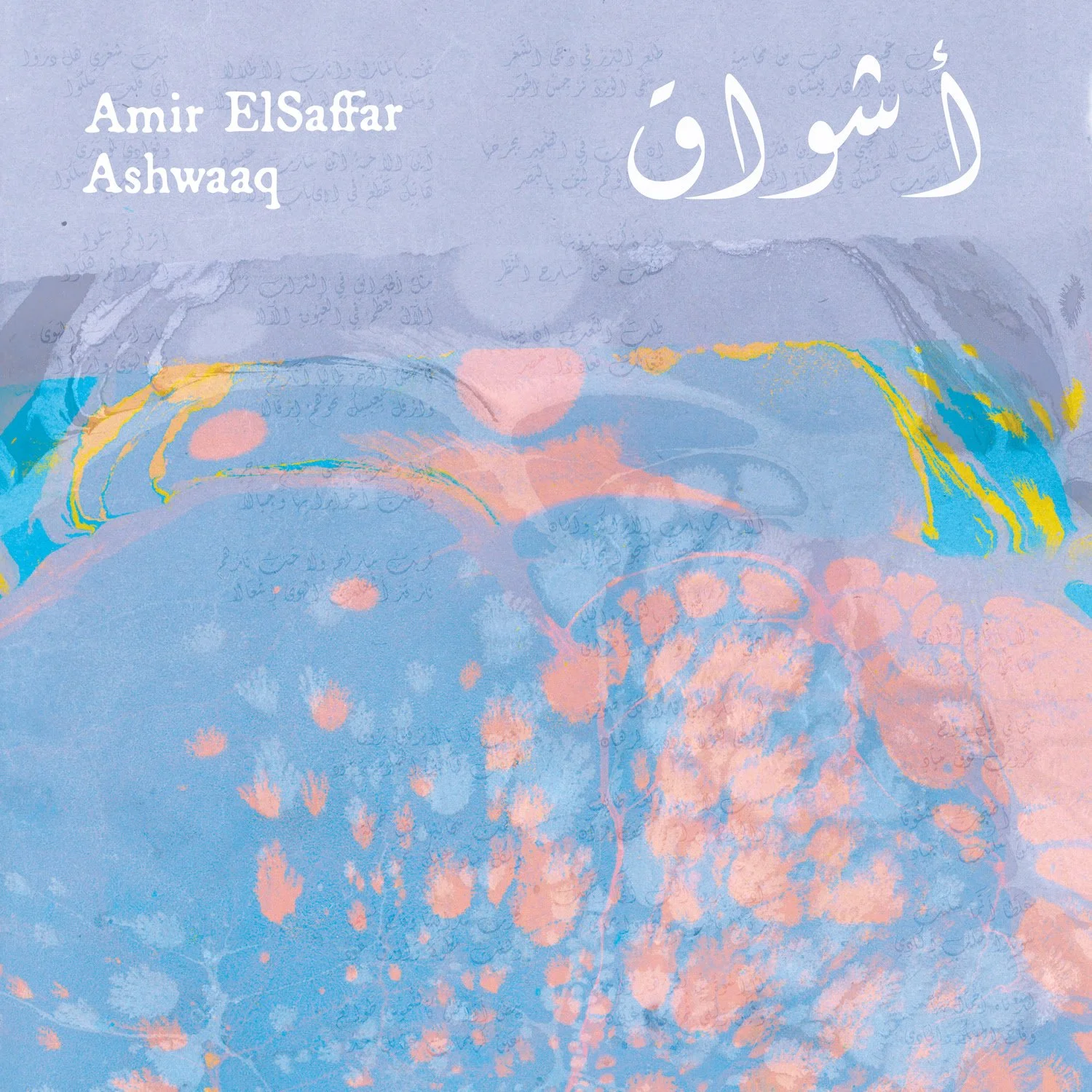
Composer and Multi-Instrumentalist Amir ElSaffar
Announces New Album Ashwaaq
Out November 6, 2026 on Maqām Records
Featuring the Poetry of 13th-Century Sufi Mystic Ibn Arabi
Sung by Aleppan vocalist Khaled AlHafez
Set to a Tapestry of Harmonized Maqam Modes
performed by String Quartet and Santur
Release Date: November 6, 2026
Pre-Order Available Now
CDs or press downloads available upon request.
On November 6, 2026, New York City-based Iraqi-American composer, trumpeter, santur player, vocalist, and modular synthesist Amir ElSaffar will release his new album Ashwaaq on Maqām Records, part of Maqām Studio, of which ElSaffar is the founder and Artistic Director. Ashwaaq is Amir ElSaffar’s ninth studio album and his second on Maqām Records. This recording is comprised of an original seven-movement composition for string quartet, voice, and santur (Iraqi hammered-dulcimer) by ElSaffar, that pairs his music with verses of poetry by thirteenth-century poet Ibn Arabi.
Alongside ElSaffar, Ashwaaq features renowned Syrian vocalist Khaled AlHafez, a carrier of traditional singing from Aleppo, and a string quartet with whom ElSaffar has deep musical relationships: his sister, Dena El Saffar on viola, with whom he co-leads an Iraqi Maqam ensemble; violinist Megan Gould, a major player in the Arabic music scene in New York who has played with Dena for over 30 years; Eylem Basaldi, an innovative violinist and improviser rooted in Turkish music; and cellist Naseem AlAtrash, a virtuoso and composer in his own right and member of the Turtle Island String Quartet.
Amir ElSaffar works at the intersections of jazz, Western classical, electro-acoustic music, and Iraqi and Arabic Maqam. Described as “the celebrated trumpeter and composer who explores vital connections between jazz and Arabic music” (New York Times), and “The Innovator” (SPIN), ElSaffar has created a unique microtonal language that merges the Arabic maqam modal system with jazz and Western classical harmony.
Muhyiddin Ibn Arabi, or simply Ibn Arabi (1165-1240), is one of the most revered Sufi philosophers and mystics, whose work embodies the ideals of love and transcendence. The epic Turjuman Al-Ashwaq (Translator of Desires) is a collection of 61 poems that explores the divine and ecstatic nature of unity amid the diversity and variety of the manifest world. On Ashwaaq, selections from Ibn Arabi’s verses are paired with voice and string quartet, using the natural and inherent sound of string instruments to interpret and reflect upon the deeper meanings of Ibn Arabi’s texts.
“My heart can take on any form: a meadow for gazelles, a cloister for monks,
For the idols, sacred ground, Ka'ba for the circling pilgrim,
the tables of the Torah, the scrolls of the Qur'án.
I profess the religion of love; wherever its caravan turns along the way, that is the
belief, the faith I keep.”
The final lines of this poem are among the most widely read and quoted in Arabic poetry, about love of the divine in its constantly changing manifestations. Here, Ibn Arabi finds the unity in all religions, faiths, and philosophies from a place free of dogma. That which is infinite cannot be grasped or contained and is perceived through an open heart “capable of every form.”
The musical side of Ashwaaq is built on much more than the series of melodies and rhythms. ElSaffar is driven by a transcultural perspective which draws on the universality of composing, listening, and reacting to music, reflecting the sentiments of Ibn Arabi’s verses. In his approach to this composition, ElSaffar explores the vast possibilities of sound, melody, harmony, and rhythm through the combination of traditional Arabic singing with the string quartet, to create a work that’s less about conventional analysis or structure and more about expressing the ecstasy, spirituality, and emotion of the poetry.
In order to best achieve his artistic vision, ElSaffar embraced a musical language known as maqam, a system of modes that has been practiced for centuries in North Africa, Western Asia, and Central Asia. These modes –– similar to Western scales but with microtones and greater melodic specificity –– determine the feeling and spiritual quality of a piece of music.
“Rather than relying on Western harmony or counterpoint, two approaches that conflict with the maqam’s inherent logic,” says ElSaffar, “the harmonies of Ashwaaq emerge from sustained microtonal resonances inherent to the maqam, and heterophony — the simultaneous renderings of a single melodic phrase with variation.”
ElSaffar finds even more inspiration in Arab musicality for Ashwaaq, using overtones of the Arab takht – chamber ensemble – as well as rhythmic pulsations that conjure folk instruments and dance. He then brings these elements together with string techniques and aspects of contemporary music. The choice to include a string quartet of Western instruments, as opposed to traditional Arab musical instruments, was guided by ElSaffar’s desire to express the plurality and multitude of meanings in Ibn Arabi’s text, a departure from the single-melody approach characteristic of traditional Maqam music. The work proposes a new form of polyphony based on the microtonal maqam, a delicate undertaking few have attempted, making it a unique contribution in both maqam music as well as Western chamber music.
Composed in 2014 on a commission from the Royaumont Foundation in France, where ElSaffar was composer-in-residence for three years, the work premiered at the Festival d’Avignon and Festival d’Aix-en-Provence, and had follow-up performances throughout Europe.
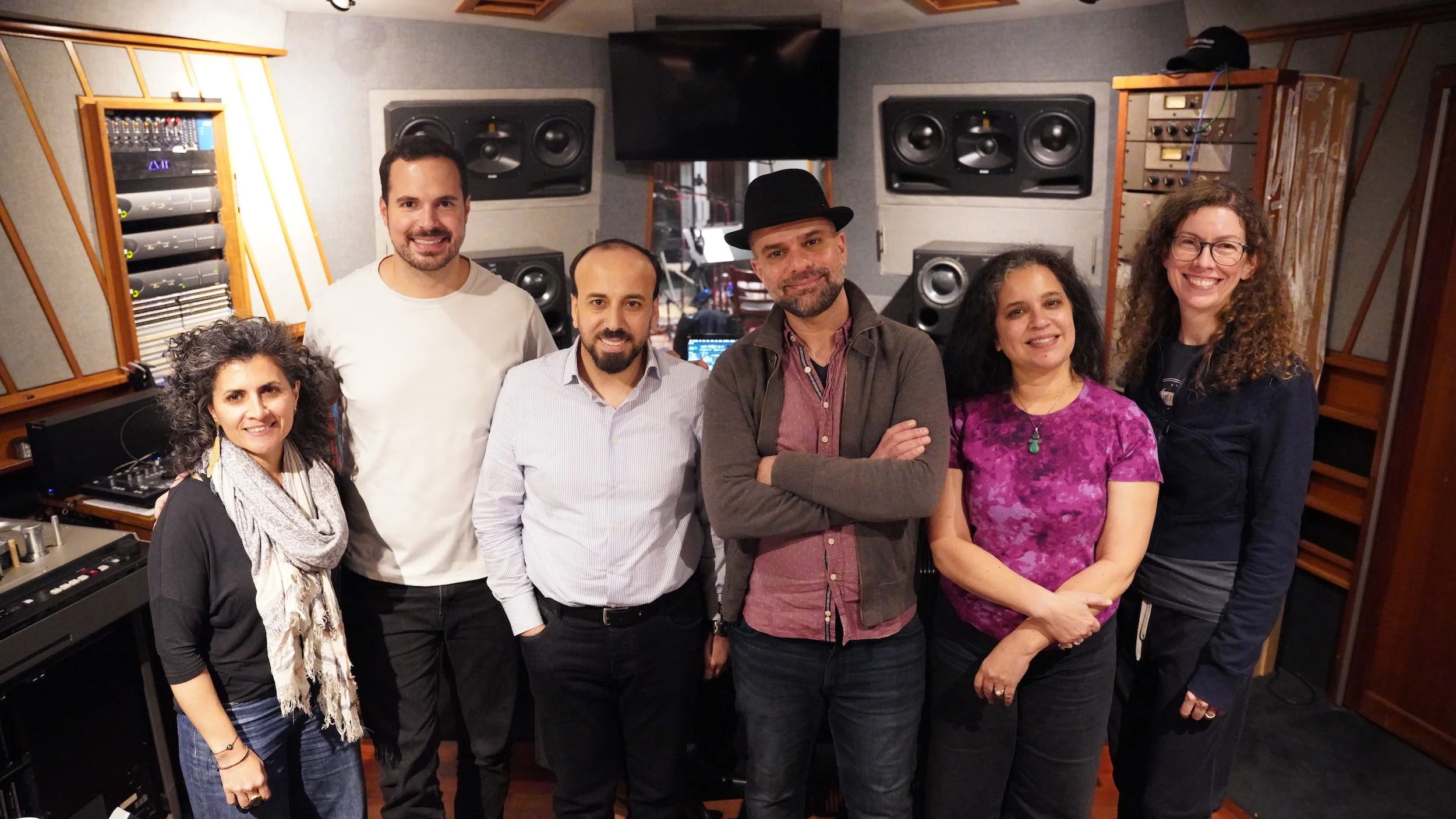
Left to right: Eylem Basaldi, Naseem AlAtrash, Khaled AlHafez, Amir ElSaffar, Dena El Saffar, Megan Gould
More about Amir ElSaffar: Amir ElSaffar leads the acclaimed six-piece Two Rivers ensemble and 17-piece Rivers of Sound Orchestra, and recently founded his New Quartet featuring microtonal piano. He is also the santur player and musical director for vocalist Hamid Al-Saadi, one of the last living practitioners of the Iraqi Maqam.
ElSaffar is the founder and Artistic Director of Maqam Studio and Maqam Records, an initiative supported by the Mellon Foundation, which seeks to preserve and foster innovation within the Maqam musical tradition of the Middle East. He is also composing an Arabic-language Maqam opera, which will have its concert premiere in 2027.
ElSaffar’s compositional output includes works for jazz ensembles, string quartets, mixed chamber ensembles, and symphony orchestras. In addition, he has led numerous hybrid projects with Raga, Flamenco, Stambeli (Tunisian Gnawa) and Subsaharan African trance music. In his most recent works he has incorporated electronic elements, such as analog modular synthesizer.
He has premiered new works at the Newport Jazz Festival, Berlin Jazz Festival, Dream City Festival (Tunisia), Festival d’Aix-en-Provence, Festival d’Avignon (France), Flamenco Biennale (Netherlands), the Mostly Mozart Festival at Lincoln Center, and Pierre Boulez Saal, among others.
ElSaffar’s awards and honors include a Mellon Foundation Arts and Culture grant (2023-2028), Doris Duke Performing Artist Award (2013), United States Artists Fellowship (2018), a Hodder Fellowship at Princeton University (2020-2021), an Opera America IDEA Grant (2025-2026) and Creative Capital Award (2026), in support of hisopera. in Arabic.
Ashwaaq
Music by Amir ElSaffar
Release Date: November 6, 2026
Maqām Records
Featuring Amir ElSaffar (santur and composition); Khaled AlHafez (voice); Megan Gould, Eylem Basaldi (violin); Dena El Saffar (viola); Naseem AlAtrash (cello)
Tracklist:
1. Introduction - Nizam [1:36]
2. I - Layta Shi'ri [2:29]
3. II - Qif Bil-Manazili [6:09]
4. III - Tal'a Al-Badru [4:28]
5. VI - Qalat [3:20]
6. V - Lam’at Lana Bil-Abraqayn [4:17]
7. VI - Al Hubbu Dini (Love is My Religion) [7:32]
8. VII - Ala Ya Banat Al-Wadi [2:37]
Total Time: [32:31]
Poetry by Ibn Arabi (1165-1240 AD)
Music by Amir ElSaffar
Produced by Maqām Records
Recorded by Marc Urselli at EastSide Sound, New York, NY on November 10, 2025
Mixed & Mastered by Marc Urselli at Audio Confidential, New York, NY
Cover Art by Amina Ahmed
Design by Buyana Jargalsaikhan
Commissioned by the Royaumont Foundation in 2014
Premiered at Festival d’Avignon and Festival d’Aix-en-Provence in July, 2014
Dedicated to the memory of Frederic Deval (1951-2016)
Excerpts from Ibn Arabi’s collection of mystical love poems, Turjumān al-Ashwāq (The Translator of Desires), written in Mecca in 1215. Excerpts from a translation into English by Michael Sells (Princeton University Press, 2021) are included in the linear notes.