
Oct 2: Sono Luminus Releases Her Only Light - Songs of Connie Converse - Vocalist Emmy Bean & Composer/Arranger Ronnie Kuller
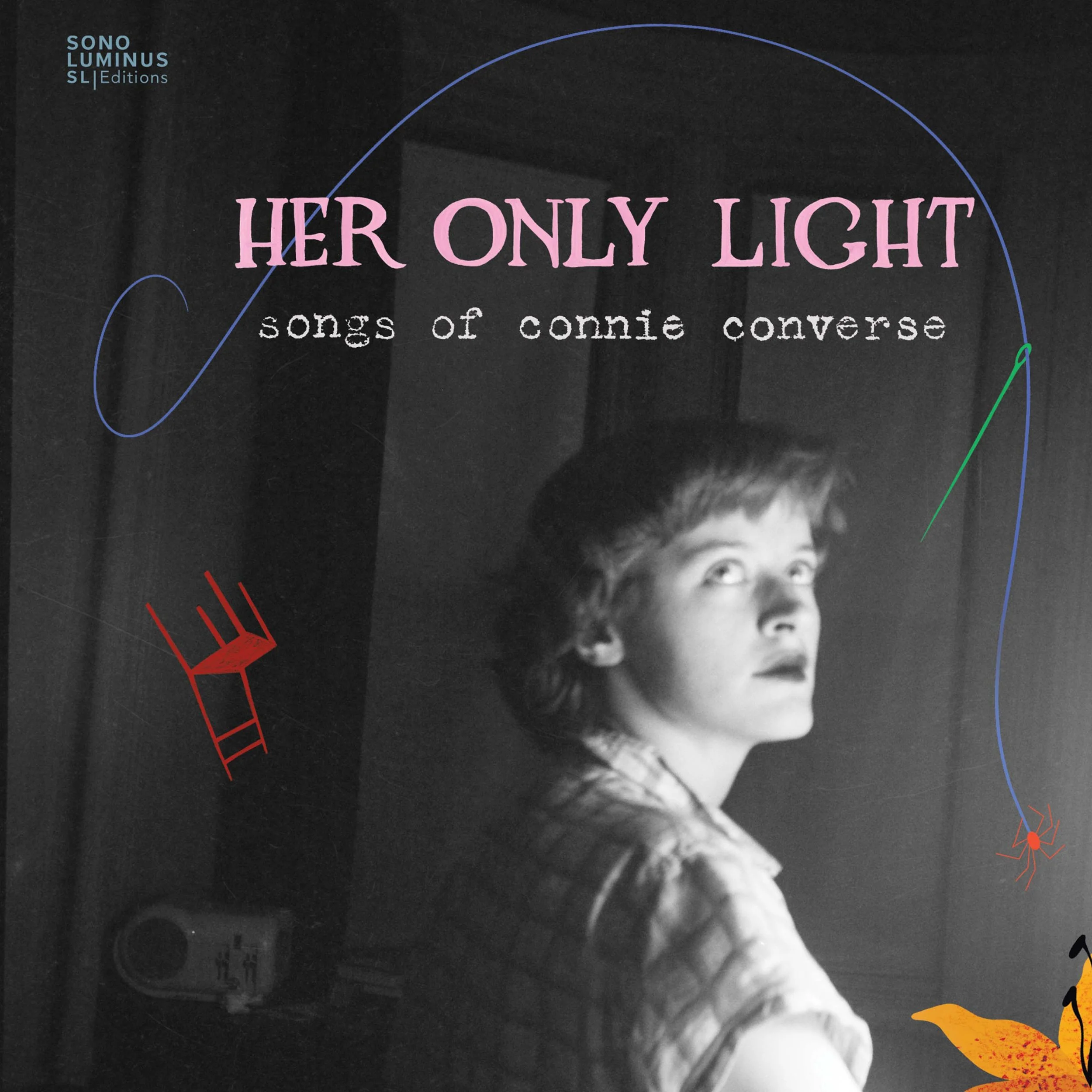
Her Only Light: Songs of Connie Converse
Vocalist Emmy Bean | Composer/Arranger Ronnie Kuller
Release Date: October 2, 2026
Sono Luminus
13 brand new arrangements of the music of Connie Converse, a pioneering singer-songwriter whose work as a composer has been largely overlooked until now. The full scope of her genius is revealed in this album of chamber music arrangements that draws together the golden threads of Converse's legacy into a tapestry of wonder, sorrow, and whimsy.
www.heronlylight.com | www.sonoluminus.com
CDs or press downloads available upon request.
Chicago, IL — The generative, ten-year collaboration between vocalist Emmy Bean and composer/arranger Ronnie Kuller is making its recording debut with Her Only Light, a new album to be released worldwide on Sono Luminus on October 2, 2026. Her Only Light features the folk songs and art songs of the enigmatic artist Elizabeth Eaton “Connie” Converse (b. 1924), whose music was largely unperformed and unrecorded in her lifetime, the pages lying dormant in the storied filing cabinet she left behind as an archive upon her mysterious disappearance in 1974.
Her Only Light realizes Converse’s harmonically adventurous, formally fluid works in newly orchestrated brilliance by Kuller, delivered empathetically by Bean with contributions by Sarah Plum, violin; Vannia Phillips, viola; Melissa Bach, cello; Lauren Hayes, harp; Emily Rach Beisel and Katherine Jimoh, clarinets.
Connie Converse was born in Laconia, New Hampshire in 1924. She was, according to her brother, a polymath genius, but dropped out of college to move to New York City. There she took up music, and — her biographer Howard Fishman writes — became “a master of the acoustic guitar,” writing tunes and lyrics that upend “the traditional format and subject of the song form.” Her efforts gained her the appreciation of musical connoisseurs, and in 1954 landed her an appearance on Walter Cronkite’s CBS morning show. In 1961, she moved to join her brother in Ann Arbor, Michigan. There she continued to compose music, play casually with friends and family, work as an editor, and engage in political activism until her disappearance in 1974, when — at the age of 50 — she wrote goodbye notes to friends and family and vanished, never to be heard from again.
While the fanbase for Converse’s folk-oriented oeuvre continues to expand exponentially, in part due to the recent re-release of her kitchen table recordings on Third Man Records (How Sad, How Lovely), her art songs have been heard with less frequency. Referred to by Converse as her “guitar songs” (folk song) and her “piano songs” (art song), Kuller and Bean discovered that these approaches had far more in common than their genre monikers might suggest. Bean writes:
“The guitar songs are no less solid, no less fully realized than the ones she wrote on piano. They completely stand on their own, and they welcome any singer with the imagination and humility to hear them and be with them. The reward of singing them is to be inside Connie's mind for a moment, to feel such great joy and such deep empathy, and to be able to smile at things that are so, so sad.”
Regarding the experience of inhabiting Converse’s deeply personal, often devastating but always witty writing, Bean goes on to explain:
“I was surprised to find how Connie's songs invite another singer into them. Some songs belong so intimately to their writer's voice—especially folk singers or singer-songwriters—that it feels wrong to sing them or hear them sung by others. It wasn't until we got into the studio that Ronnie and I figured out that I could be the same singer throughout; there was no need to over-stylize the art songs or under-sing the folk songs. Together we were able to find an approach that honored the depth of her writing in both contexts, and that kind of broke the spell of genre over the whole thing.”
“When How Sad, How Lovely was first released, I was captivated by the beauty and immediacy of Connie's songs to such a degree that they became part of me," says Kuller. “As I continued learning and singing them, I found that they rewarded close study: graceful chromaticism and time-stretching, unexpected harmonic shifts, every element carefully considered and in service of the deceptively simple whole. Connie's Piano Songs initially presented themselves as a radical departure, but as I listened more closely, I could hear how the compositional language of her guitar songs had developed into something even more adventurous, and I was excited to find the throughlines and connect the dots. During the dormancy of the pandemic, yearning for closeness and meaning and music, Emmy and I conjured up Her Only Light to save us from our solitude, a project in which we would use a carefully chosen palette of lush orchestral color to imagine for Connie's songs an alternate existence. It was a joy to build this pedestal that is also a bridge connecting the full breadth of Connie's incredible compositions.”
Bean says, “The song ‘Father Neptune’ became important to me during quarantine. Her lyrics paint a picture of a woman whose relationship to her man is defined by distance and longing and even queerness (all those bearded men on the ship, no need for wives ‘except on shore’...) and her own belief – he might as well be imaginary, but his presence, even if only in her imagination, keeps her alive, keeps her heart beating. She says so much in so few words here, and those words are so funny and so true; I felt a kind of kinship to her as I turned that song over and over in my head, and I wanted to sing it to everyone I knew. So I guess that was the moment I knew I wanted to take this on as a project.”
Between Kuller’s beautifully nuanced arrangements and Bean’s sumptuous delivery, the result is an entrancing one, illuminating an altogether new perspective of an artist unfairly neglected in her lifetime for both longtime devotees and new listeners alike.
Ronnie Kuller is a composer, arranger, pianist and accordionist who has performed with the Chicago Symphony Orchestra, the Lyric Opera of Chicago, the Joffrey Ballet, the Chicago Philharmonic, and Mister Tom Musick, and whose compositions have been performed at Ear Taxi Festival and recorded onto wax cylinder at Edison National Historical Park. She lives in Chicago with her wonderful husband Patrick and amazing daughter Sylvie.
Emmy Bean is a singer, performer, and interdisciplinary artist. She writes songs and performs as a soloist and with the trio 80 Foots. She has been seen in Facility Theater’s Little Match Girl Passion , Theater Oobleck’s Baudelaire in a Box, and The Carter Family Family Show with the Neo-Futurists. She has collaborated with ~Nois saxophone quartet, Stacy Rene Erenberg, Erica Mott, Naima Lowe, Opera-Matic, and Beyond This Point. She improvises with the vocal ensemble Tender.
Sarah Plum, violin
Vannia Phillips, viola
Melissa Bach, cello
Lauren Hayes, harp
Emily Rach Beisel, clarinets
Katherine Jimoh, clarinet
For more information, visit: www.heronlylight.com
[liner notes linked here]
[complete descriptions of each track linked here]
Her Only Light: Songs of Connie Converse
Sono Luminus Records | Release Date: October 2nd, 2026
1. Talkin Like You (Two Tall Mountains)
2. I Have Considered the Lillies
3. Vanity of the Vanities
4. The Rainmaker
5. Father Neptune
6. Incommunicado
7. anyone lived in a pretty how town (text by e.e. cummings)
8. Cassandra’s Entrance
9. The Age of Noon
10. Song for Old Wars
11. She Think of Heaven
12. She Devises a Lullaby
13. One by One
Engineered and mixed by Mathieu Lejeune at Lost Boy Sound, Chicago, IL
Produced by Ronnie Kuller and Emmy Bean
Assistant Producer: Emma Hospelhorn
Cover photograph by Elizabeth Converse
Artwork by Lizi Breit
Layout: Joshua Frey
Liner notes: Doyle Armbrust
Executive producer: Collin J. Rae