
June 5: ECM New Series releases Heiner Goebbels's Walden featuring Ensemble Modern Orchestra and Peter Eötvös, conducter
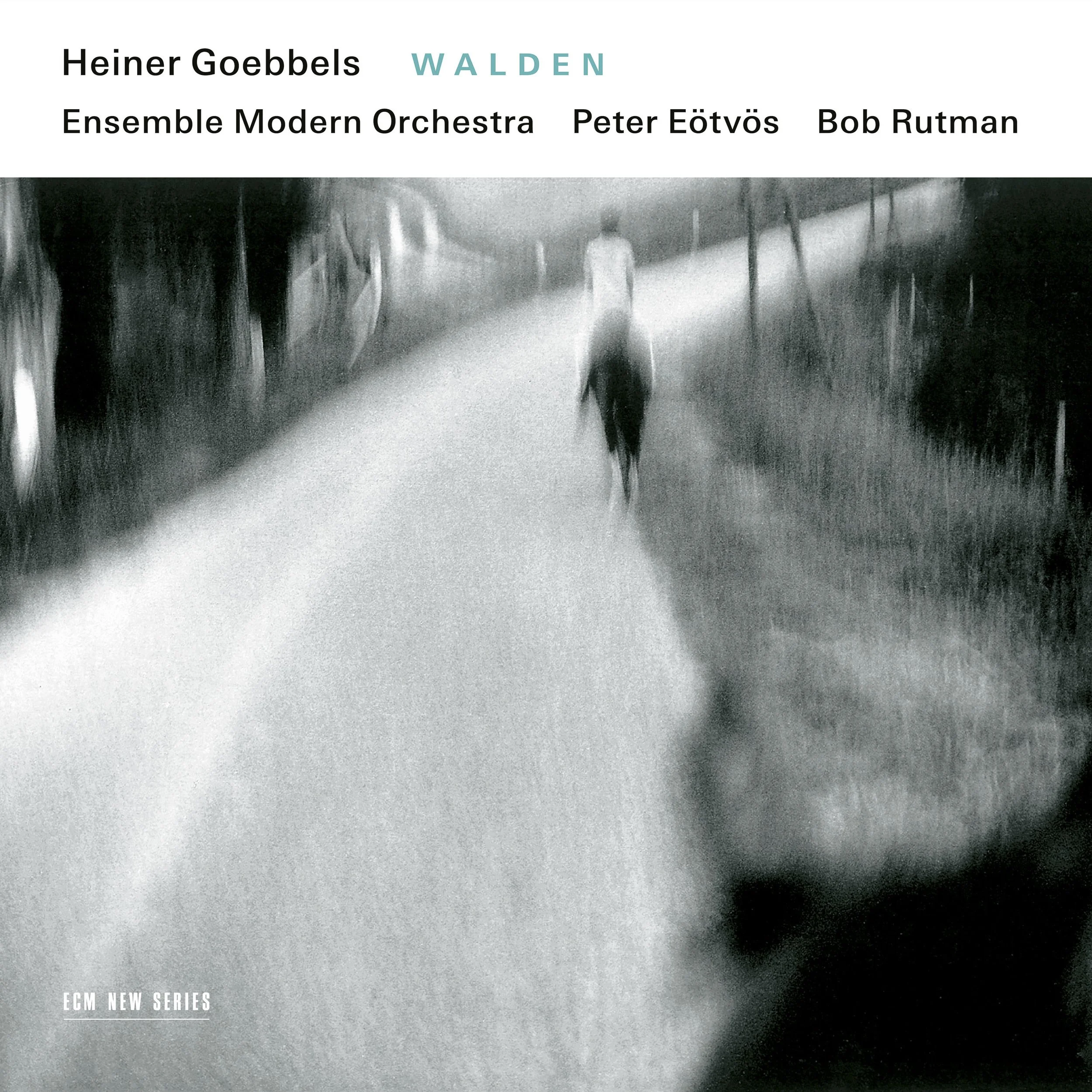
Heiner Goebbels
WALDEN
Ensemble Modern Orchestra
Peter Eötvös, conducter
Rob Rutman, speaker
ECM New Series 2878
Release: June 5, 2026
Press downloads and CDs available upon request
“Walden consists of a series of musical sketches inspired by the 1854 novel of the same name by Henry David Thoreau” – thus reads the short description of this project by Heiner Goebbels himself. But those familiar with the oeuvre of the German trans-media conceptualist and composer know that with Goebbels it’s never quite that simple. In his 1998 creation Walden, composed for expanded orchestra with speaker, Goebbels incorporates a wide-flung stream of inspirations and approaches, spanning excerpts from Thoreau’s text “Walden”, soundscape-design in the spirit of audio plays, arsenals of outlandish instruments and sonic layouts as much at home in the avantgarde as they borrow from popular music, all brought to life with Peter Eötvös conducting and Bob Rutman – a main figure in this project – in the role of the narrator.
In his liner note, the composer explains how he initially envisioned this work as a “counterpoint to the urban imagery of Surrogate Cities (1994). Still, my view of Thoreau’s text is far less idyllic, and my relationship to his notion of nature more distant than the original source might suggest. Walden, for me, is a piece about the tension between withdrawal and openness—between individual self-discovery and the constant presence of the outside world. It is not a romantic vision of nature, but rather a reflection on the conditions of our existence today.”
The dichotomy of nature and civilization is subtly dissociated musically throughout nine movements, with the industrial side of things represented in sampled beats, distorted percussion and wailing horns that could perhaps reference city life at night. This work is clearly not meant to be understood as Goebbels’s literal setting of Thoreau’s text, but as an abstract engagement with it and its general topics of solitude, sounds and nature as well as with subsequently published works that likewise examined Thoreau’s text. In other words: “Walden”, but through the looking glass.
Besides narrating excerpts of Thoreau’s writing, the German visual artist, composer and instrument builder Rutman can also be heard in a more declamatory role, exclaiming with vehemence, sometimes singing in the khoomei technique, then becoming part of the orchestra playing the steel cello and bow chimes, both instruments of his own design. Together with Frankfurt’s Ensemble Modern orchestra under Eötvös’s direction the music is fashioned in multiple layers. They pull and tug at each other in one moment, then merge in ominous unison passages, rich in dissonance and tied together by sections not completely unlike recitatives in operas.
In his extensive examination and analysis of Goebbels’s Walden (an excerpt of it is found in the booklet accompanying the album, the complete text can be found here: www.ecmrecords.com/2878), originally published in 2002, writer Frank Mehring observes how in his composition, “Goebbels points to the mediating function of literary texts, which playfully incorporate the past into new scenarios”. In that vein, his piece unfurls like a web of references, with pockets of meaning and symbolism dangling from individual strings.
From trip-hop pastiches and mesmerizing ambient structures to imposing orchestral surges on the far-out edges of contemporary music making, Walden is a testament to the visionary ways of Heiner Goebbels, the composer, mid-career, and stands as one of the most innovative chapters of his body of work to come to light yet. The album is made up of recordings stemming from the work’s premiere performances at the Philharmonie Köln and the Alte Oper Frankfurt, in November 1998.