
Announcing the Isabella Stewart Gardner Museum’s Winter/Spring 2026 Weekend Concert Series
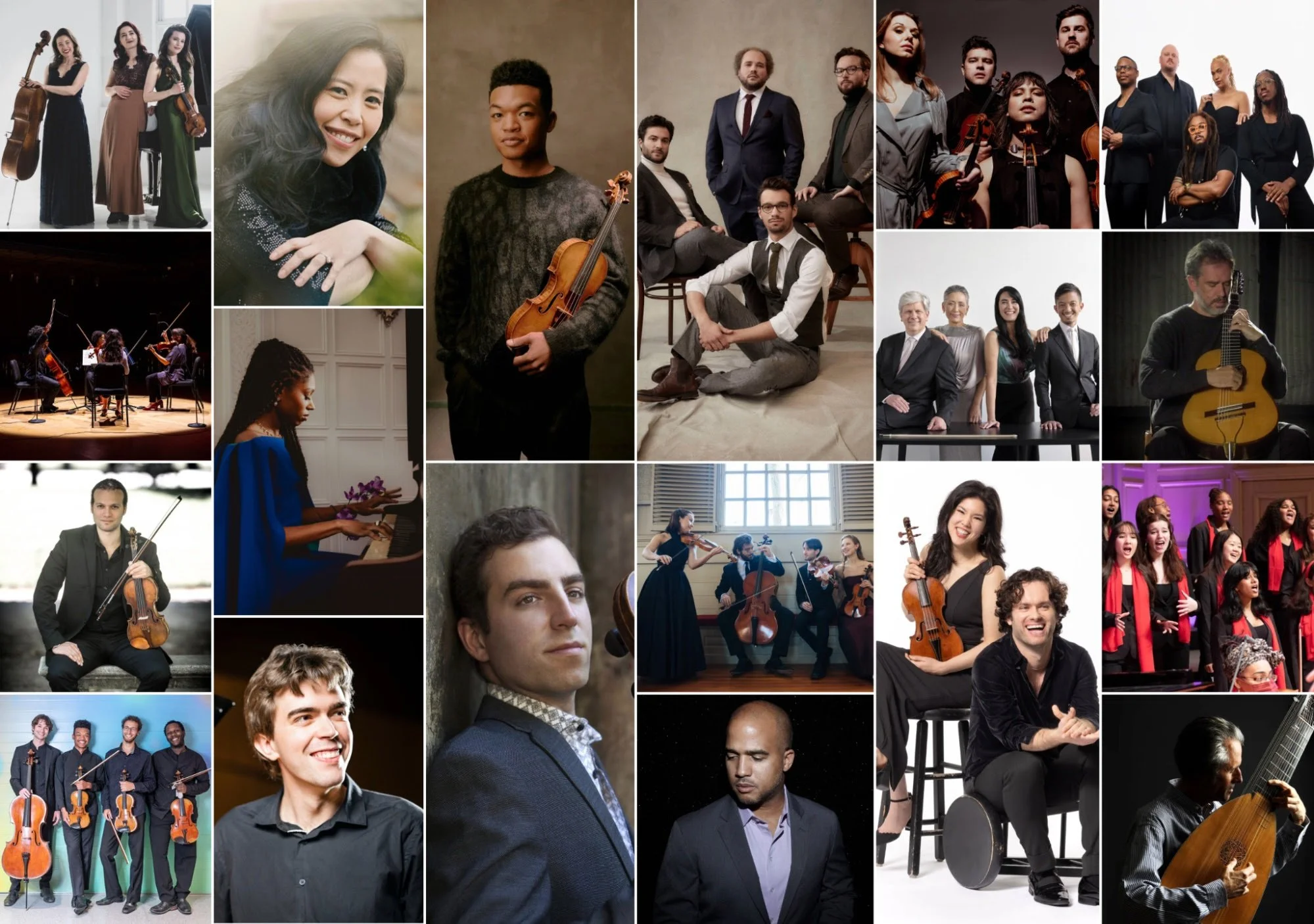
Press photos available here.
Announcing the Isabella Stewart Gardner Museum’s
Winter/Spring 2026 Weekend Concert Series
Fifteen Performances at Calderwood Hall from January through May
Information & Tickets: gardnermuseum.org/about/music
BOSTON, MA – The Isabella Stewart Gardner Museum announces its Winter/Spring 2026 Weekend Concert Series, a fifteen-concert season curated by Abrams Curator of Music George Steel running from January 25 through May 17, 2026, featuring world-class artists in the Museum’s extraordinary Calderwood Hall—a 300-seat “sonic cube” with three levels of balconies designed so that 80% of seats are front row, creating a uniquely intense and intentional listening experience.
George Steel’s music programming for the Museum continues founder and legendary arts patron Isabella Stewart Gardner’s vision of bringing together musicians and audiences for inspiring gatherings. Dating to 1927, the Gardner’s Weekend Concert Series is the longest running museum music program in the country. Much like Isabella Stewart Gardner did in her time, Steel champions unknown repertoire and embraces new works, creates connections and builds community among musicians, and supports them by presenting them in new endeavors and collaborations. His programming also frequently draws on the history of the Gardner Museum, featuring instruments from the Museum’s collection and music by composers who were associated with its founder. In honoring Isabella Stewart Gardner’s musical legacy, Music at the Gardner remains strongly committed to broadening the repertoire of music presented to include previously overlooked and marginalized composers as well as performers of all backgrounds.
The Gardner Museum's Winter/Spring 2026 Weekend Concert Series includes: Rachell Ellen Wong, the first Baroque violinist to receive an Avery Fisher Career Grant, making her Calderwood Hall debut with collaborators from her Twelfth Night Ensemble (January 25); a chamber music program created especially for the Gardner Museum by violinist Romuald Grimbert-Barré, cellist Tommy Mesa, and pianist Albert Cano Smit (February 1); the celebrated Claremont Trio returning with Louise Farrenc's Piano Quintet No. 1 alongside music by Ravel and Shulamit Ran (February 8); the impossibly talented Attacca Quartet performing a Museum-commissioned Boston premiere by David Lang paired with works by Mendelssohn and Bartók (February 22); Boston piano star Gloria Chien joining the young German stars of the Goldmund Quartet for Amy Beach's Piano Quintet alongside music by Haydn and Grażyna Bacewicz (March 1); the great American lutenist Hopkinson Smith in a special 400th anniversary celebration of John Dowland (March 8); Boston's beloved Borromeo String Quartet in Schubert's "Death and the Maiden" and works by Vijay Iyer, Caroline Shaw, and Jessie Montgomery (March 15); longtime Gardner Museum collaborators Castle of Our Skins presenting a portrait concert of violinist-composer Daniel Bernard Roumain (March 29); superstar guitarist Paul Galbraith performing on his remarkable eight-string “Brahms Guitar” (April 5); the return of virtuoso violinist Randall Goosby in a program of music by Beethoven, Debussy, and Amy Beach (April 12); Boston Children's Chorus honoring the legacy of civil rights icon Melnea Cass (April 18); the remarkable Imani Winds in a varied program including music by Simon Shaheen, Stevie Wonder, Valerie Coleman, and Fazil Say (April 19); the Diderot String Quartet performing Haydn and Beethoven on period instruments (April 26); stellar pianist Isata Kanneh-Mason in a thoughtful program including Beethoven's "Moonlight" and "Waldstein" sonatas, Ravel's Gaspard de la nuit, and selections by Dobrinka Tabakova (May 10); and the Renaissance String Quartet (violinists Randall Goosby and Jeremiah Blacklow, violist Jameel Martin, and cellist Daniel Hass) with works by Florence Price, Brahms, and Daniel Hass (May 17).
“I am very excited about our Winter/Spring season in Calderwood Hall,” George Steel says. “Violinist Randall Goosby returns for two concerts: a solo recital and a performance with his group Renaissance String Quartet. We have guitar and lute recitals—Calderwood Hall is the ideal venue for those. And a wonderful range of chamber music: piano quintets from Amy Beach and Louise Farrenc, string quartets from Schubert, Mendelssohn, Haydn, Daniel Bernard Roumain, and more. Please join us for a season of beauty and rediscovery.”
Winter/Spring 2026 Weekend Concert Series Overview
The Winter/Spring 2026 Weekend Concert Series opens on January 25 with Rachell Ellen Wong, the first Baroque violinist ever to receive an Avery Fisher Career Grant, making her overdue Gardner Museum debut in a program of trio sonatas with collaborators from her group, the excellent (and seasonally named) Twelfth Night Ensemble. Wong is a major talent—eloquent, virtuosic, and always musicianly. The program spans the great era of Baroque violin music, from Biber’s Sonata V in F major through Corelli’s celebrated “La Folia” Sonata, Tartini’s diabolical Sonata in G minor (nicknamed “The Devil’s Trill”), J.S. Bach’s Sonata No. 2 in A major for violin and harpsichord, and other gems by Veracini, Royer, and Leclair.
On February 1, violinist Romuald Grimbert-Barré, who comes from a family of exceptional French/Caribbean musicians, presents a program of chamber music created especially for the Gardner Museum, joined by two equally talented colleagues—the Spanish/Dutch pianist Albert Cano Smit and Tommy Mesa, the Cuban American cellist who won the 2025 Avery Fisher Career Grant on the heels of winning the 2023 Sphinx Competition. Their program ranges from Clara Schumann’s Three Romances and Brahms’ Piano Trio No. 3 in C Minor, to Debussy’s Sonata for cello and piano, Lili Boulanger’s D’un soir triste, and Jessie Montgomery’s contemporary Duo for violin and cello.
The celebrated Claremont Trio returns to the Gardner Museum on February 8, joined by violist Rosemary Nelis and bassist Bradley Aikman, for a performance of 19th-century French composer Louise Farrenc’s Piano Quintet No. 1 in A minor, Op. 30. Farrenc, whose music is only now receiving the attention it deserves, was a formidable pianist and composer whose piano quintet stands alongside the finest chamber works of her era. The trio will also take on Ravel’s luscious piano trio and Shulamit Ran’s yearning Soliloquy, which grew out of her work on an operatic adaptation of The Dybbuk by S. An-sky.
The impossibly talented Attacca Quartet returns to Calderwood Hall on February 22, bringing Bartók’s pungent fourth quartet, which mixes Hungarian folk music and modernism with foot-stomping ferocity. Mendelssohn’s Apollonian musicianship will be on display in his elegant String Quartet in E minor. The program is balanced by the Boston premiere of a Museum-commissioned work by David Lang, daisy, from the composer who created his “in-ear opera” true pearl for the Gardner Museum’s Tapestry Room in 2018. Lang’s music continues to surprise and delight with its inventive approaches to texture and form.
Boston piano star Gloria Chien returns to the Gardner Museum on March 1 to join the young German stars of the Goldmund Quartet in composer Amy Beach’s Piano Quintet, one of the finest works by the greatest of Boston’s “Second New England School” of composers. The Goldmunds will offer Haydn’s String Quartet in E-flat major, nicknamed his “Joke” quartet, from his astonishing Opus 33 set of quartets, along with the fourth quartet of Polish mid-century modernist Grażyna Bacewicz. Her music, only now finding a wider audience, balances Baltic intensity and Mendelssohnian wit.
On March 8, the great American lutenist Hopkinson Smith celebrates the life and music of John Dowland, the great Elizabethan songwriter and performer. This concert, celebrating the 400th anniversary of Dowland’s death in 1626, will be built around lute transcriptions of Dowland’s celebrated Lachrimae Pavanes, a set of exquisite variations on his own song, Flow My Tears, one of the supreme examples of glorious Tudor musical melancholy. Smith’s artistry and deep understanding of this repertoire make him the ideal guide to Dowland’s world. This is a special event not to be missed.
Boston’s beloved Borromeo String Quartet pays a visit to the Gardner Museum on March 15 with a program built around Schubert’s monumental “Death and the Maiden” quartet, one of his supreme late masterpieces and a paragon of the Romantic spirit. The Borromeos also bring a quartet by jazz pianist and composer Vijay Iyer, who is Harvard’s Franklin D. and Florence Rosenblatt Professor of the Arts and a MacArthur Fellow. Nicholas Kitchen has arranged a pair of preludes and fugues from Bach and Shostakovich, while Entr’acte by Museum-favorite Caroline Shaw and Jessie Montgomery’s Source Code round out this adventurous and eclectic program that showcases the quartet’s remarkable range.
The Gardner’s longtime collaborators, Castle of Our Skins, perform a portrait concert on March 29 of violinist, composer, and musical firebrand Daniel Bernard Roumain, joined by the composer himself on electric violin along with Val-Inc as sound chemist. This concert includes three string quartets from Roumain’s cycle of musical portraits of major Black figures: String Quartet No. 1, “X” (1993); String Quartet No. 2, “King” (2001); and String Quartet No. 4, “Angelou” (2004). Roumain’s music thrillingly mixes classical American music, jazz, and hip-hop, all transformed through his own unique voice. His quartets are powerful testimonies to the lives and legacies of Malcolm X, Martin Luther King, Jr., and Maya Angelou.
On April 5, the Gardner Museum presents superstar Paul Galbraith, one of the great guitarists of our time and a superb interpreter. With the music of J.S. Bach and Albéniz at the heart of his program, Galbraith will perform on his remarkable eight-string “Brahms Guitar,” which he holds like a cello. His instrument and his artistry are sui generis. There is simply no one else doing what Galbraith does. The program ranges from Dowland’s Elizabethan gems through J.S. Bach’s French Suites and Partitas, to a sonata by Haydn, Albéniz’s masterpieces Suite Española and España, Ravel’s Menuet sur le nom d’Haydn, and Lennox Berkeley’s Quatre pièces. There is no better place to hear Galbraith’s miraculous playing than in the superb acoustics of Calderwood Hall.
Virtuoso violinist Randall Goosby returns on April 12 with pianist Zhu Wang for an intimate recital of epic music. Two major sonatas bookend the program: Debussy’s elusive and gorgeous sonata is paired with Beethoven’s sunny F major essay in the form. The concert also includes Southland Sketches by Harry Burleigh, who was key in forging a quintessential American musical language, modifying the gorgeous modal inflections of spirituals with the chromatic ambiguities of Wagner’s harmony. Romance by Boston’s Amy Beach, the best of the Second New England School of composers, gorgeously drinks from a similar Wagnerian well. Dvořák’s Four Romantic Pieces provide a bridge between these worlds, showing how Romanticism and folk traditions can be seamlessly interwoven.
Boston Children’s Chorus honors the remarkable legacy of Melnea Cass, the “First Lady of Roxbury,” on April 18. A tireless advocate for justice, Cass championed women’s suffrage, Black employment, early childhood education, care for the elderly, and civil rights leadership as president of Boston’s NAACP. Her lifelong commitment to equity shaped generations in Boston and her influence continues to resonate today. Audiences are invited to celebrate the enduring impact of this powerful yet often unsung Boston icon through a program of music that reflects her spirit of activism, community, and hope.
The celebrated wind quintet Imani Winds returns to the Gardner Museum on April 19 with a typically wide-ranging program showcasing works by composer-performers. Including the great American ‘oud player Simon Shaheen, Turkish pianist Fazil Say, the nonpareil Stevie Wonder, and Imani’s own Valerie Coleman, this program demonstrates the quintet’s commitment to expanding the wind repertoire with music that crosses cultural and stylistic boundaries. From Wonder’s jubilant Overjoyed to Coleman’s evocative Red Clay & Mississippi Delta, from Finnish composer Kalevi Aho’s substantial Wind Quintet No. 1 to Paquito D’Rivera’s A Little Cuban Waltz, this wonderful program is full of color and invention.
Four superlative musicians (all colleagues in the Baroque ensemble ACRONYM) come together as the Diderot String Quartet on April 26 to perform crowning glories of the Classical era on period instruments with gut strings. Haydn’s Opus 20 “Sun” Quartets may be his finest works for string quartet. These players will know how to bring out the contrapuntal splendors of Haydn’s writing—the second quartet concludes with a witty fugue on four subjects. The program is completed by Beethoven’s String Quartet No. 6 in B-flat major, the last of his Opus 18 set, showing the younger composer already pushing at the boundaries Haydn had established.
The stellar pianist member of the great English Kanneh-Mason family of musicians, Isata Kanneh-Mason, takes a moment away from the concerto stage on May 10 to bring this thoughtfully constructed program to Calderwood Hall: two of Beethoven’s best-loved sonatas, the “Moonlight” and the “Waldstein;” Ravel’s astonishing three-movement tour-de-force Gaspard de la nuit, inspired by the dark poetry of Aloysius Bertrand; and pair of shorter works, Halo and Nocturne, by Bulgarian-British composer Dobrinka Tabakova.
The Gardner Museum is thrilled and fortunate to present the Renaissance String Quartet on May 17, for the closing performance of the Winter/Spring 2026 Weekend Concert Series. These four terrific musicians (violinists Randall Goosby and Jeremiah Blacklow, violist Jameel Martin, and cellist Daniel Hass) find time in their busy touring lives as soloists and chamber musicians to perform together as a quartet. Brahms’ String Quartet No. 2 in A minor anchors the program with its characteristic blend of passion and intellectual rigor. The concert also includes the great American composer Florence Price’s String Quartet No. 1 in G Major. Price had a special gift for quartet writing; the exquisite and eloquent slow movement of her first quartet shows her love of American song, especially Black spirituals. The program closes with String Quartet No. 1, “Love and Levity,” by Daniel Hass, the cellist in the Renaissance String Quartet. He describes the piece as “Beethovenian in its thematic and structural tautness, but even more so in its motion towards excess.”
Winter/Spring 2026 At-a-Glance Concert Schedule
January 25: Twelfth Night Ensemble
February 1: Romuald Grimbert-Barré, violin; Tommy Mesa, cello; Albert Cano Smit, piano
February 8: Claremont Trio
February 22: Attacca Quartet
March 1: Goldmund Quartet with Gloria Chien, piano
March 8: Hopkinson Smith, lute
March 15: Borromeo String Quartet
March 29: Castle of Our Skins with Daniel Bernard Roumain, electric violin and Val-Inc, sound chemist
April 5: Paul Galbraith, guitar
April 12: Randall Goosby, violin with Zhu Wang, piano
April 18: Boston Children’s Chorus: The Road She Paved
April 19: Imani Winds
April 26: Diderot String Quartet
May 10: Isata Kanneh-Mason, piano
May 17: Renaissance String Quartet
All concerts take place on Sundays at 1:30 pm (except for the Boston Children’s Chorus which performs on Saturday, April 18 at 2pm) in Calderwood Hall at the Isabella Stewart Gardner Museum (25 Evans Way, Boston, MA).
Ticketing Information
Tickets are available at gardnermuseum.org/about/music or by calling the Box Office at 617 278 5156. For additional information including about accessibility, please contact boxoffice@isgm.org.
About the Isabella Stewart Gardner Museum
The Isabella Stewart Gardner Museum invites you to escape the ordinary in a magical setting where art and community come together to inspire new ways of envisioning our world. Embodying the fearless legacy of its founder, the Museum offers a singular invitation to explore the past through a contemporary lens, creating meaningful encounters with art and joyful connections for all. Modeled after a Venetian palazzo, unforgettable galleries surround a luminous Courtyard and are home to masters such as Rembrandt, Raphael, Titian, Michelangelo, Whistler, and Sargent. The Renzo Piano Wing provides a platform for contemporary artists, musicians, and scholars and serves as an innovative venue where creativity is celebrated in all of its forms.
Isabella Stewart Gardner Museum • 25 Evans Way, Boston, MA 02115 • Hours: Open Weekends from 10 am to 5 pm, Weekdays from 11am to 5 pm and Thursdays until 9 pm. Closed Tuesdays. • Admission: Adults $22; Seniors $20; Students $15; Free for members, children under 18, everyone on their birthday, and all named “Isabella” • $2 off admission with a same-day Museum of Fine Arts, Boston ticket • For information 617 566 1401 • Box Office 617 278 5156 • www.gardnermuseum.org
Music at the Gardner is supported by Manitou Fund. The Museum thanks its generous concert donors: The Coogan Concert in memory of Peter Weston Coogan; Fitzpatrick Family Concert; James Lawrence Memorial Concert; Alford P. Rudnick Memorial Concert; David Scudder in memory of his wife, Marie Louise Scudder; Wendy Shattuck Young Artist Concert; and Willona Sinclair Memorial Concert. The piano is dedicated as the Alex d’Arbeloff Steinway. The harpsichord was generously donated by Dr. Robert Barstow in memory of Marion Huse, and its care is endowed in memory of Dr. Barstow by The Barstow Fund. Music at the Gardner is also supported in part by Barbara and Amos Hostetter, Nicie and Jay Panetta, and the Massachusetts Cultural Council, which is supported by the state of Massachusetts and the National Endowment for the Arts.