
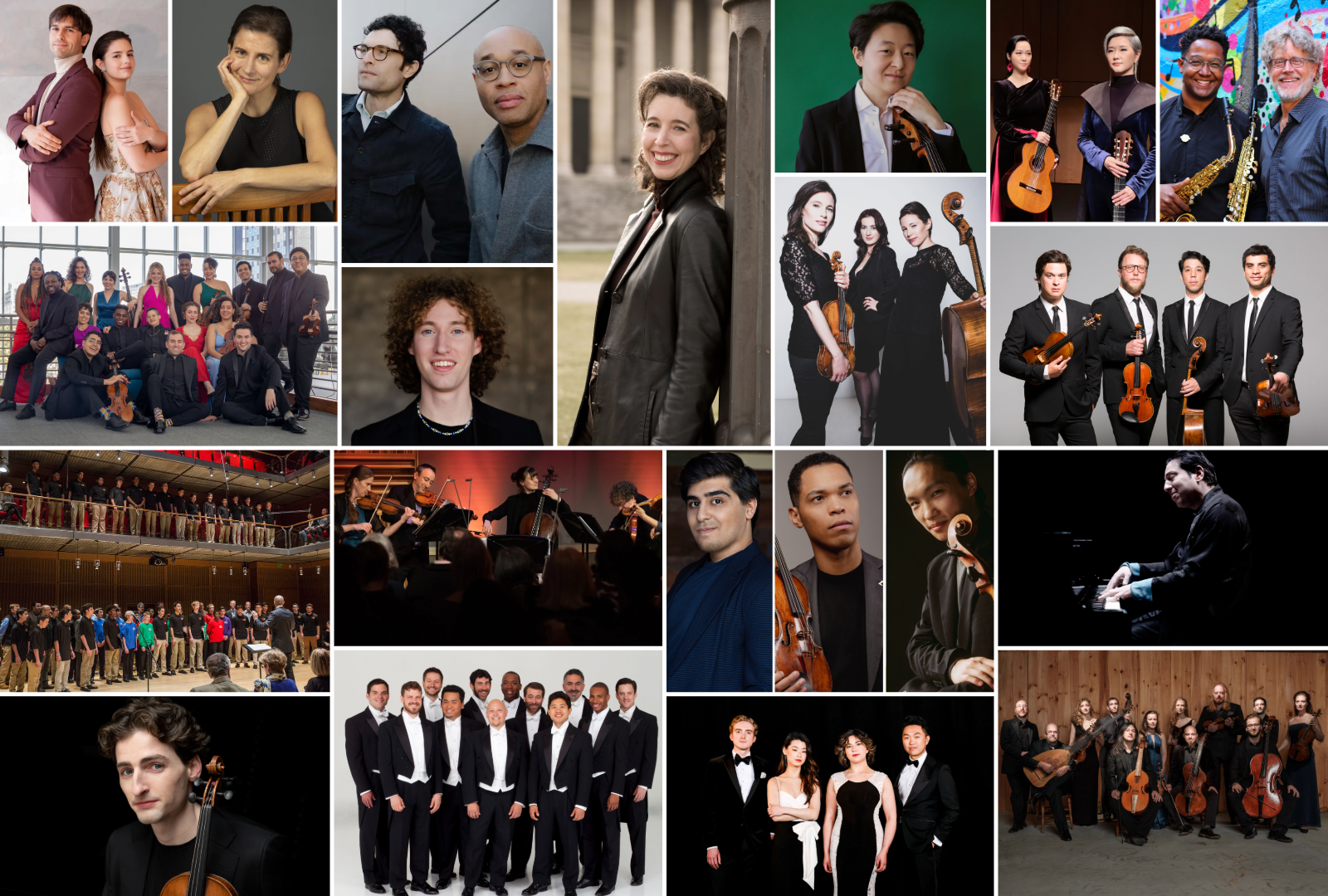
Press photos available here.
Announcing the Isabella Stewart Gardner Museum’s Winter/Spring 2027 Weekend Concert Series
Marking 100 Years of the Music Program
Sixteen Performances at Calderwood Hall from January through May,
Including a Two-Concert Celebration of Beethoven 200 Years After His Death
Information & Tickets:gardnermuseum.org/about/music
Tickets On Sale to the General Public on November 25, 2026
BOSTON, MA (November 18, 2026) – The Isabella Stewart Gardner Museum announces its Winter/Spring 2027 Weekend Concert Series, a sixteen-concert season curated by Abrams Curator of Music George Steel running from January 24 through May 16, 2027, featuring world-class artists in the Museum’s extraordinary Calderwood Hall—a 300-seat “sonic cube” with three levels of balconies designed so that 80% of seats are front row, creating a uniquely intense and intentional listening experience. Tickets will go on sale to the general public on November 25, 2026.
The Gardner Museum’s Winter/Spring 2027 Weekend Concert Series includes the Gardner debut of 16-year-old violin sensation Ava Pakiam (January 24); Gardner Museum favorites the Claremont Trio returning with music by Beethoven, Dvořák, and Kaija Saariaho (January 31); pianist Aaron Diehl and composer-pianist Timo Andres in a two-piano program blurring the lines between jazz and classical (February 7); the Sphinx Virtuosi in a survey of American music from the 1920s to today (February 14); the internationally acclaimed Beijing Guitar Duo in a virtuosic selection of music from around the world (February 21); the Paris-based Van Kuijk String Quartet in its Calderwood Hall debut, featuring a rarely heard quartet by Dutch composer Henriëtte Bosmans (February 28); the rising stars OAK Trio in a folk-inspired program (March 7); saxophonist Steven Banks and pianist Xak Bjerken in a program showcasing Banks’s limitless range (March 14); early music supergroups ACRONYM and Chanticleer joining forces in the sacred music of Giovanni Valentini (March 21); 2025 American Piano Awards winner Michael Davidman with the Viano String Quartet (March 28); Boston Baroque’s X-tet in masterpieces of the trio sonata repertoire (April 4); Boston Children’s Chorus in Echoes of Freedom (April 10); violinist Joshua Brown with pianist Dina Vainshtein in a program anchored by French sonatas (April 11); cellist Yi Qun Xu and pianist Anna Polonsky in a program that includes a cello sonata by Fauré dedicated to Isabella Stewart Gardner’s close friend Charles Martin Loeffler (April 25); and a two-concert celebration marking 200 years since Beethoven’s death, with piano giants Angela Hewitt (May 9) and Fazıl Say (May 16).
Music was beloved by Museum founder Isabella Stewart Gardner (1840–1924). She hosted many recitals in her home, among the artworks she had collected. When she opened the Museum in 1903, she had the Boston Symphony Orchestra consecrate the occasion with a concert. Music continued to play a central role in her vision throughout her life. In 1927, the Museum’s trustees began presenting concerts to continue in her legacy. Throughout 2027, the Gardner Museum is celebrating 100 years of the music program.
“In this anniversary year, I am thrilled to share a season built to honor Isabella’s unique vision,” George Steel says. “It is a particular joy to fill this extraordinary place with music. As Isabella did, we are bringing artists at the summit of their careers, as well as younger artists making their debuts. The season offers music at the center of the repertoire as well as extraordinary works played less than they ought to be. In the latter category is the magnificent piano quintet of Sergei Taneyev, which debut artist Michael Davidman will perform on half of his recital. We end the season with a two-concert tribute to Beethoven, whose life-mask Isabella included in the Yellow Room among letters and photographs of musicians she most admired.”
George Steel’s music programming for the Museum continues founder and legendary arts patron Isabella Stewart Gardner’s vision of bringing together musicians and audiences for inspiring gatherings. Dating to 1927, the Gardner’s Weekend Concert Series is the longest-running museum music program in the country. Much like Isabella Stewart Gardner did in her time, Steel champions unknown repertoire and embraces new works, creates connections and builds community among musicians, and supports them by presenting them in new endeavors and collaborations. His programming also frequently draws on the history of the Gardner Museum, featuring instruments from the Museum’s collection and music by composers who were associated with its founder. In honoring Isabella Stewart Gardner’s musical legacy, Music at the Gardner remains strongly committed to broadening the repertoire of music presented to include previously overlooked and marginalized composers as well as performers of all backgrounds.
Winter/Spring 2027 Weekend Concert Series Overview
The Winter/Spring 2027 Weekend Concert Series opens on January 24 with the Gardner Museum debut of Ava Pakiam, a star on the rise. Only 16 years old, the Bay Area violinist is already making a name for herself in recitals and as a concerto soloist. Her technique is dazzling, but more astonishing is her musical insight and interpretive sorcery, which would be enviable in an artist of any age. Pakiam’s program spans the mid-Romantic period to the Harlem Renaissance and includes Brahms’s Violin Sonata No. 3 in D minor, Debussy’s Sonata for Violin and Piano, Ravel’s Tzigane, and William Grant Still’s Summerland.
Gardner Museum favorite the Claremont Trio (violinist Emily Bruskin, cellist Julia Bruskin, and pianist Sophiko Simsive) returns on January 31 with three works rooted in the earth. Beethoven’s Piano Trio in E-flat major, Op. 70, No. 2 (1808) breathes the rural air of Jedlesee on the Danube, a riverside village where his patron and confidant Anna Maria Erdődy frequently hosted the composer. Dvořák’s “Dumky” Trio, a spellbinding medley of linked folk ballads, alternately tragic and celebratory, conjures his Slavic homeland. Kaija Saariaho wrote Light and Matter (2014) while living in New York, where her Columbia apartment had a commanding view of Olmsted’s Morningside Park. She writes of being inspired by the “continuous transformation of light on the glinting leaves and the immobile trunks of the solid trees.”
On February 7, Aaron Diehl returns to the Gardner with his frequent collaborator, composer-pianist Timo Andres, to take on a spectacular two-piano program. Jazzy tours-de-force by composer-performers Francis Poulenc (his Sonata for piano four-hands), Thelonious Monk (Green Chimneys), and Billy Strayhorn (Tonk, the classic party piece written for Strayhorn and Duke Ellington) are complemented by Andres’s own works How can I live in your world of ideas?, Pavane (pour un compositeur défunt), and his recent Monk Nocturnes (2025). Julia Wolfe’s my lips from speaking, originally for six pianos and here arranged for two, transmutes a fragment of Aretha Franklin’s “Think.” The anchor for the program is the fugal finale from Bach’s Concerto for two harpsichords in C major, presented in his original version for two players alone.
Sphinx Virtuosi returns to Calderwood Hall on February 14 with a program that celebrates the broadness of American sound. Jessie Montgomery’s brilliant Banner (2014) asks, “What does an anthem for the 21st century sound like in today’s multicultural environment?” Stravinsky’s neon-bright Concerto for Strings in D, “Basle,” written while he was living in Hollywood, finds a counterpart in the taut and driving Sinfonietta for Strings (2020) of Puerto Ricancomposer Roberto Sierra. Florence Price’s gorgeous Andante from her String Quartet No. 2 is founded on the bedrock sound of spirituals, and Ravel’s “Blues,” from his Violin Sonata No. 2, is one of his many valentines to Black music. Rounding out the program, Canadian composer Rachel McFarlane, best known for her film and video game music, offers a panoramic view of American history in American Dialogue (2025).
Heralded by Classical Guitar Magazine as “having the star potential to serve as inspiration for new generations of guitarists to come,” Meng Su and Yameng Wang—the internationally recognized Beijing Guitar Duo—come to Calderwood Hall on February 21. This remarkable pair of guitarists, both born in Qingdao, China, and now based in California, bring fearsome virtuosity and razor-sharp ensemble to a program spanning three centuries of music from around the world including Telemann’s Partie Polonaise, Giuliani’s Variazioni Concertanti, Agustín Barrios Mangoré’s Un sueño en la floresta and Vals de Primavera, Radamés Gnattali’s Suite Retratos, and two works by Tan Dun, his Eight Memories in Watercolor and Seven Desires.
Founded in Paris, the excellent Van Kuijk String Quartet (violinists Nicolas Van Kuijk and Sylvain Favre-Bulle, violist Emmanuel François, and cellist Anthony Kondo) brings its “style, energy, and sense of risk” (The Guardian) to its Calderwood Hall debut on February 28. The Quartet opens with a Mozart’s String Quartet No. 16 in E-flat major, K. 428, one of his superb set of six quartets dedicated to his fellow Viennese composer and friend Haydn, complemented by Schumann’s String Quartet, Op. 41, No. 2, dedicated to Schumann’s friend Mendelssohn. By request, the quartet brings the string quartet by Dutch composer and pianist Henriëtte Bosmans, whose brave and fascinating life remains on par with her remarkable compositions. In 1940, the Boston Symphony Orchestra performed her violin concerto. Two years later, Bosmans was barred from performing in the Netherlands due to her mother being Jewish. Throughout the Nazi occupation of the Netherlands, Bosmans protected her mother and penned what became known as an “anthem of liberation” as the war ended.
The extraordinary young musicians of the OAK Trio (violinist Joshua Brown, cellist Leland Ko, and pianist Evren Ozel) are already on their way to stardom and make their Calderwood Hall debut on March 7. Their program features three works that draw on folk music: Amy Beach’s reimagination of Inuit melodies through a Romantic and impressionistic lens in her Piano Trio in A minor, Op. 150; Gabriela Lena Frank’s Four Folk Songs, an homage to the melodies and rhythms of her mother’s home country of Peru; and Dvořák’s third piano trio, full of Bohemian folk influences. Founded in 2024 with original violinist Nathan Amaral, the trio’s current members’ accolades include Evren Ozel receiving the Bronze Medal and Mozart Concerto Prize at the 2025 Cliburn International Piano Competition, Joshua Brown winning second and Audience Prize at the 2024 Queen Elisabeth Competition, and Leland Ko taking home joint first prize at the 2024 Naumburg International Competition and third prize at the 2026 Queen Elisabeth Competition.
Saxophonist Steven Banks, who performs on March 14 with pianist Xak Bjerken, is a unique figure. In his hands, the saxophone becomes an instrument of limitless refinement and expressivity—and the ideal vehicle for seldom-heard works by Beethoven (Seven Variations on Bei Männern, welche Liebe fühlen), Saint-Saëns (Bassoon Sonata, Op. 168), and Barber (Cello Sonata, Op. 6). In his rendition of John Musto’s song cycle Shadow of the Blues, which sets four poems by Langston Hughes to music, the emotional brilliance of the poet is maintained, even wordlessly. Two newer works, Carlos Simon’s hear them and Banks’s own As I Am, performed by special request, point to a rich future for the saxophone as a recital instrument.
On March 21, two early music supergroups, ACRONYM and Chanticleer, join forces to bring to light the sacred music of Venetian-born Baroque composer Giovanni Valentini (about 1582–1649). Valentini held one of the most prestigious musical posts of his day, musical director in the Habsburg court for Holy Roman Emperor Ferdinand II, yet he has been largely forgotten by history. His music is full of bold harmonic shifts and rhythmic daring. Unrelated keys and extreme chromaticism dazzle the ear, and obscure time signatures keep musicians and audiences on their toes. The program includes his Litaniae Lauretanae, motets including O Vos Omnes and Mensa Sacra, and instrumental canzonas and sonatas.
One of the most striking moments of pianist Michael Davidman’s dazzling first-place performance at the American Piano Awards was his breathtaking account of the little-known Piano Quintet of Sergei Taneyev. By special request, on March 28 he brings this monumental, brooding work to Calderwood Hall with the Viano String Quartet (violinists Lucy Wang and Hao Zhou, violist Aiden Kane, and cellist Tate Zawadiuk), along with two towering solo works, Schubert’s Piano Sonata No. 19 in C minor and Chopin’s Ballade No. 4 in F minor. Davidman appears as winner of the 2025 American Piano Awards and Christel DeHaan Fellowship.
The star players of Boston Baroque’s newest ensemble, the X-tet, come to Calderwood Hall on April 4 to explore masterpieces of the trio sonata, the most popular chamber music form of the Baroque—comparable to the string quartet in the Classical era and beyond. Despite its name, the trio sonata requires at least four players—two melody lines and a continuo group of at least two players. X-tet’s program includes three experts on the form. Arcangelo Corelli, known as the “new Orpheus of our times,” is the unquestioned early master, while Henry Purcell’s glorious, often chromatic trios, including “The Great Chaconne” and the “Golden” Sonata, were informed by his admiration for Roman trios by composers like the wildly influential Lelio Colista.
Inspired by their tour to South Africa, Boston Children’s Chorus presents Echoes of Freedom in a special performance on Saturday, April 10 at 1:30pm, exploring music born of struggle, hope, and the enduring belief that a more just world is possible. Drawing from South African freedom songs as well as music from the United States and beyond, the program highlights songs that sustained communities through oppression, gave voice to resistance, and carried dreams of liberation into the future. Echoes of Freedom invites audiences to imagine a world where opportunity is not determined by race, class, or circumstance, but where communities work together to create a more equitable future.
Violinist Joshua Brown returns to Calderwood Hall for a solo recital on April 11 with pianist Dina Vainshtein. Praised for his “richness of sound, elegance of reading…commitment of every moment at the service of the work” (La Libre), Brown is well on his way to a major career, performing as a concerto soloist and superb chamber musician around the world. He comes to the Gardner on the heels of his 2025 Avery Fisher Career Grant, bringing a bespoke program. At its heart is Fauré’s Violin Sonata No. 1, a piece that John Singer Sargent himself played for Isabella Stewart Gardner with their good friend, composer Charles Martin Loeffler. The streetwise sonata of Francis Poulenc offers a different vantage on French music, as does Violinesque by the remarkable José White Lafitte, the biracial Cuban composer whose dazzling showpieces took Paris by storm in the middle of the 19th century. The program also includes Tōru Takemitsu’s lyrical early work Distance de fée and Augusta Read Thomas’s Rush, an ode to the rush of coffee and sugar.
Fauré and Poulenc have a second exciting rencontre in Calderwood Hall on April 25, when two masters of their respective instruments, cellist Yi Qun Xu and pianist Anna Polonsky, come together for a high-energy, virtuosic program full of range and surprising connections. At its heart is Fauré’s Cello Sonata No. 2, which he dedicated to Isabella Stewart Gardner’s close friend Charles Martin Loeffler; Loeffler, Gardner, and Sargent all counted Fauré as a friend. The program also includes Poulenc’s Cello Sonata from 1948; two works by the modern master Joan Tower, Très Lent (Hommage à Messiaen), a hushed homage to composer Olivier Messiaen, and the exhilarating Wild Run; and Adrien-François Servais’s madcap mash-up of hits from Rossini’s Barber of Seville.
Two hundred years after his death, Beethoven remains an undiminished titan of music. The Gardner Museum honors this important anniversary with a two-concert celebration by two modern giants of the keyboard. On May 9, Angela Hewitt performs a recital of Beethoven sonatas spanning his full career, from the two Op. 49 sonatas through the “Pathétique” and “The Tempest” to the late Sonata No. 31 in A-flat major, Op. 110. On May 16, composer-pianist Fazıl Say returns to the Gardner to complete this Beethoven tribute with two great middle-period sonatas, the “Waldstein” and the “Appassionata,” paired with his own works for solo piano, to be announced.
Winter/Spring 2027 At-a-Glance Concert Schedule
January 24: Ava Pakiam, violin
January 31: Claremont Trio
February 7: Aaron Diehl and Timo Andres, piano duo
February 14: Sphinx Virtuosi
February 21: Beijing Guitar Duo
February 28: Van Kuijk String Quartet
Willona Sinclair Memorial Concert
March 7: OAK Trio
This concert is the annual Coogan Concert made possible by Deborah W. Coogan and is in memory of her late husband Peter Weston Coogan.
March 14: Steven Banks, saxophone with Xak Bjerken, piano
March 21: ACRONYM and Chanticleer—Sacred Music of Giovanni Valentini
March 28: Michael Davidman, piano with the Viano String Quartet
James Lawrence Memorial Concert
April 4: Boston Baroque’s X-tet
April 10: Boston Children’s Chorus—Echoes of Freedom
April 11: Joshua Brown, violin and Dina Vainshtein, piano
Wendy Shattuck Young Artist Concert
April 25: Yi Qun Xu, cello and Anna Polonsky, piano
May 9: Celebrating Beethoven—Angela Hewitt, piano
May 16: Celebrating Beethoven—Fazıl Say, piano
All concerts take place on Sundays at 1:30 pm (except for the Boston Children’s Chorus concert, which takes place on Saturday, April 10) in Calderwood Hall at the Isabella Stewart Gardner Museum (25 Evans Way, Boston, MA).
Ticketing Information
Tickets ($25-$99) are available at gardnermuseum.org/about/music or by calling the Box Office at 617 278 5156. All concert tickets include Museum admission.
About the Isabella Stewart Gardner Museum
The Isabella Stewart Gardner Museum invites you to escape the ordinary in a magical setting where art and community come together to inspire new ways of envisioning our world. Embodying the fearless legacy of its founder, the Museum offers a singular invitation to explore the past through a contemporary lens, creating meaningful encounters with art and joyful connections for all. Modeled after a Venetian palazzo, unforgettable galleries surround a luminous Courtyard and are home to masters such as Rembrandt, Raphael, Titian, Michelangelo, Whistler, and Sargent. The Renzo Piano Wing provides a platform for contemporary artists, musicians, and scholars and serves as an innovative venue where creativity is celebrated in all of its forms.
Isabella Stewart Gardner Museum • 25 Evans Way, Boston, MA 02115 • Hours: Open Weekends from 10 am to 5 pm, Weekdays from 11 am to 5 pm, and Thursdays until 9 pm. Closed Tuesdays. • General admission: Adults $25; Seniors $22; Students $15; Free Thursdays from 5 – 9 pm and for members, children 17 and under, and everyone named Isabella • Information: 617 566 1401 • Box Office: 617 278 5156 • www.gardnermuseum.org
Music at the Gardner is supported by the Nora McNeely Hurley Foundation. The Museum thanks its generous concert donors: The Coogan Concert in memory of Peter Weston Coogan; Fitzpatrick Family Concert; James Lawrence Memorial Concert; Scott Nickrenz Concert; Alford P. Rudnick Memorial Concert; David Scudder in memory of his wife, Marie Louise Scudder; Wendy Shattuck Young Artist Concert; and Willona Sinclair Memorial Concert. The piano is dedicated as the Alex d’Arbeloff Steinway. The harpsichord was generously donated by Dr. Robert Barstow in memory of Marion Huse, and its care is endowed in memory of Dr. Barstow by The Barstow Fund. Music at the Gardner is also supported in part by Barbara and Amos Hostetter, Joseph Mari, Sallie and Jim McGregor, and Nicie and Jay Panetta.