
Oct. 6-7: The Jupiter String Quartet Gives Two Performances in Buffalo Presented by the Buffalo Chamber Music Society & University at Buffalo
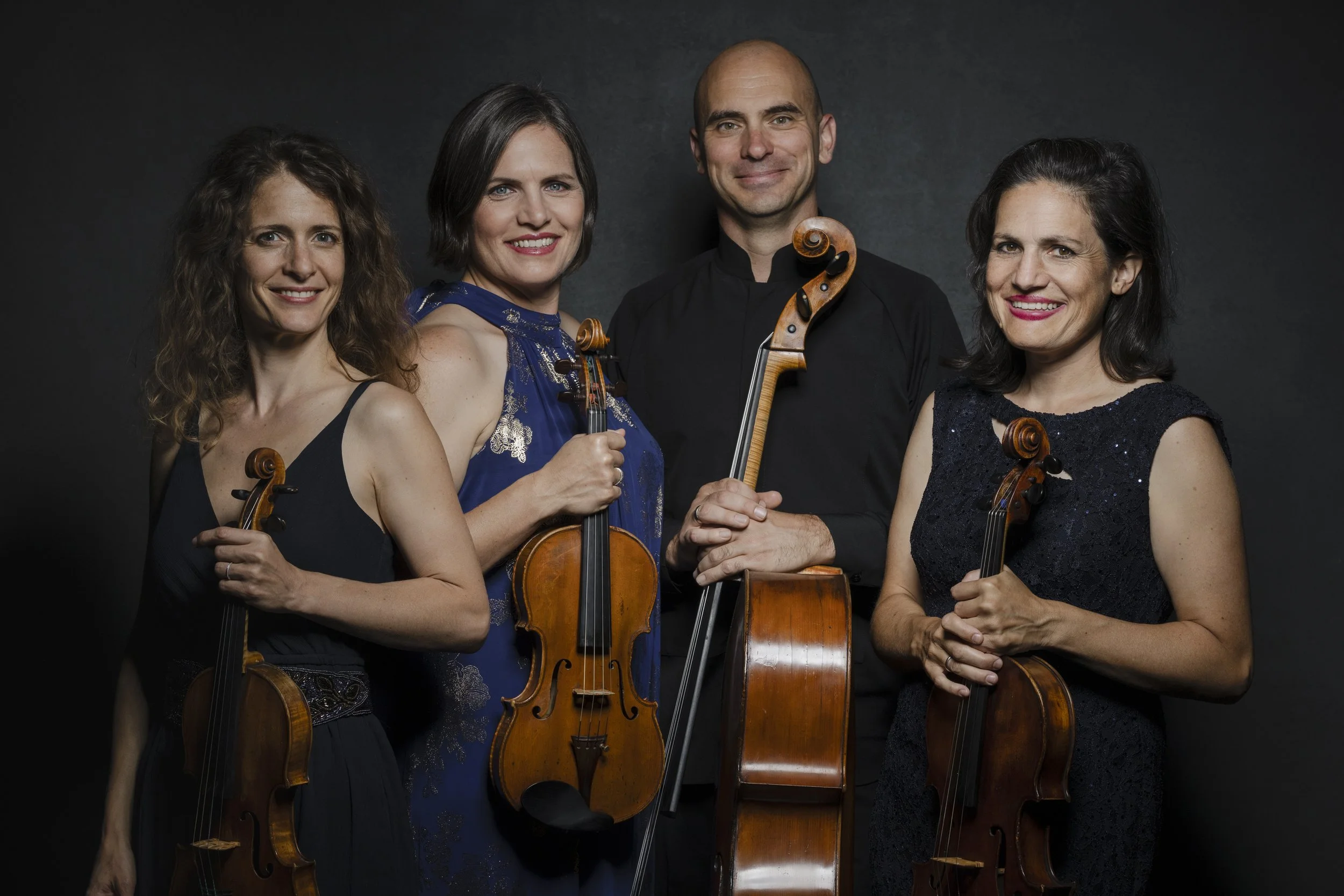
Photo of the Jupiter Quartet by Todd Rosenberg available in high resolution at www.jensenartists.com/artists-profiles/jupiter-string
The Jupiter String Quartet
Gives Two Performances in Buffalo on October 6 and 7
Presented by the Buffalo Chamber Music Society & University at Buffalo
“technical finesse and rare expressive maturity” – The New Yorker
Tuesday, October 6, 2026 at 7:30pm
Presented by the Buffalo Chamber Music Society (BCMS)
Mary Seaton Room, Kleinhans Music Hall | 3 Symphony Circle | Buffalo, NY
Tickets and Information
Wednesday, October 7, 2026 at 7:30pm
Presented by the University at Buffalo in Partnership with BCMS
Slee Hall, Lippes Concert Hall | 120 Coventry Rd. | Buffalo, NY
Tickets and Information
Buffalo, NY – The Jupiter String Quartet, described by The Cleveland Plain-Dealer as “an alert and energetic ensemble, with plenty of communication and an individual sonic sheen,” will give two concerts in Buffalo in early October. On Tuesday, October 6, 2026 at 7:30pm, they perform at Kleinhans Music Hall (3 Symphony Circle) presented by the Buffalo Chamber Music Society (BCMS). On Wednesday, October 7, 2026 at 7:30pm, they perform in Lippes Concert Hall (120 Coventry Road) co-presented by BCMS and the University at Buffalo.
The Jupiter String Quartet is a particularly intimate group, consisting of violinists Mélanie Clapiès and Meg Freivogel, violist Liz Freivogel (Meg’s older sister), and cellist Daniel McDonough (Meg’s husband, Liz’s brother-in-law). Founded in 2001, the ensemble is firmly established as an important voice in the world of chamber music, and exudes an energy that is at once friendly, knowledgeable, and adventurous. They give concerts all over the country, and are artists-in-residence and faculty at the University of Illinois, Urbana-Champaign. The quartet chose its name because Jupiter was the most prominent planet in the night sky at the time of its formation and the astrological symbol for Jupiter resembles the number four.
The Jupiter’s program on October 6 features music by Austrian composers from three centuries, each very different in style and mood, from the extroverted expressions of Joseph Haydn’s String Quartet in C Major, Op 76 No. 3 “Emperor” from 1797; to the heartfelt passion felt in Franz Schubert’s String Quartet in A minor, D 804, “Rosamunde” from 1824; and the intense emotional arc of Alban Berg’s Lyric Suite from 1925. Haydn’s “Emperor” quartet was the result of his becoming acquainted with an emerging genre of music, the national anthem, during his visits to London in the 1790s. When he returned to Vienna, he proposed to music patron Baron von Swieten that he should compose a new work that would serve a similar function in Austria as “God Save the King” did in England. He did so in 1797, and the song became an instant success, later becoming the Austrian national anthem in 1847. Haydn made it the focal point of his bold new string quartet, incorporating the melody and a set of variations into the piece. Alban Berg was inspired to write his Lyric Suite by his infatuation with Hanna Fuchs-Robettin – he hid her initials in the piece using the musical notes, and encoded other symbols and messages about their love in the six-movement work. Franz Schubert’s “Rosamunde” quartet represents a turning point in his music from lighter and more fanciful work, to a more intense, darker tone. Schubert’s failing health and a troubled love affair are thought to be the causes behind his artistic shift. The piece was the only one of his chamber works to be published during his lifetime. Its nickname is the title of a play for which Schubert wrote incidental music, that includes some of the same music as this quartet.
The Jupiter’s concert on October 7 will include four pieces, each showcasing the human connections that are often inextricably woven into music – Clarice Assad’s Canções da America; Juri Seo’s Respiri; Shulamit Ran’s Quartet No. 3, Glitter, Doom, Shards, Memory; and Johannes Brahms’ Quartet No. 2 in A minor, Op. 51, No. 2. Brazilian American composer, pianist, vocalist, and educator Clarice Assad is known for writing music with evocative colors and rich textures, which she imparts to Canções da America, a work celebrating the many cultures and histories found in South America through its own musical styles, from the Milonga dance of Uruguay to the choro of Brazil and the Tango of Argentina. Assad dedicated the piece to Argentine composer Claudia Montero, who died in 2021. Korean-born American composer Juri Seo wrote her piece Respiri in 2016, in memory of British composer Jonathan Harvey. Seo wrote her dissertation on Harvey’s string quartets and corresponded extensively with him during his final year of life. Israeli-American composer Shulamit Ran’s third string quartet – Glitter, Shards, Doom, Memory – is a tribute to the Jewish artist Felix Nussbaum and other victims of the Holocaust. The work’s name is tied to “Glitter and Doom,” the title of an exhibition previously on display at the Metropolitan Museum of Art. Brahms’s expansive and lyrical Quartet No. 2 in A minor, Op. 51, No. 2 was premiered in 1873 by the string quartet of his good friend, Hungarian violinist Joseph Joachim. Joachim's motto was “Frei, aber einsam” (Free, but lonely). In the opening movement of the quartet, Brahms encoded a special message for his friend, using the pitches F-A-E and also F-A-F to counter with, “Frei, aber froh” (Free, but glad). This personal connection between composer and performer was also evident in Brahms' use of Hungarian melodies and musical gestures in the second movement and the Finale.
The Jupiter Quartet has performed in some of the world’s finest halls, including New York City’s Carnegie Hall and Lincoln Center, London’s Wigmore Hall, Boston’s Jordan Hall, Mexico City's Palacio de Bellas Artes, Washington, D.C.’s Kennedy Center and Library of Congress, Austria’s Esterhazy Palace, and Seoul’s Sejong Chamber Hall. Their major music festival appearances include the Aspen Music Festival and School, Bowdoin International Music Festival, Cape Cod Chamber Music Festival, Rockport Music Festival, Caramoor International Music Festival, Music at Menlo, Tucson Winter Chamber Music Festival, the Banff Centre, the Seoul Spring Festival, and many others. In addition to their performing career, they have been artists-in-residence at the University of Illinois Urbana-Champaign since 2012, where they maintain private studios and direct the chamber music program. Their chamber music honors and awards include the grand prizes in the Banff International String Quartet Competition and the Fischoff National Chamber Music Competition; the Young Concert Artists International auditions in New York City; the Cleveland Quartet Award from Chamber Music America; an Avery Fisher Career Grant; and a grant from the Fromm Foundation. From 2007-2010, they were in residence at the Chamber Music Society of Lincoln Center’s Chamber Music Two. The Jupiter has recorded extensively for the Marquis Classics label, Azica Records, and Orchid Classics.
For more information, visit www.jupiterquartet.com.