
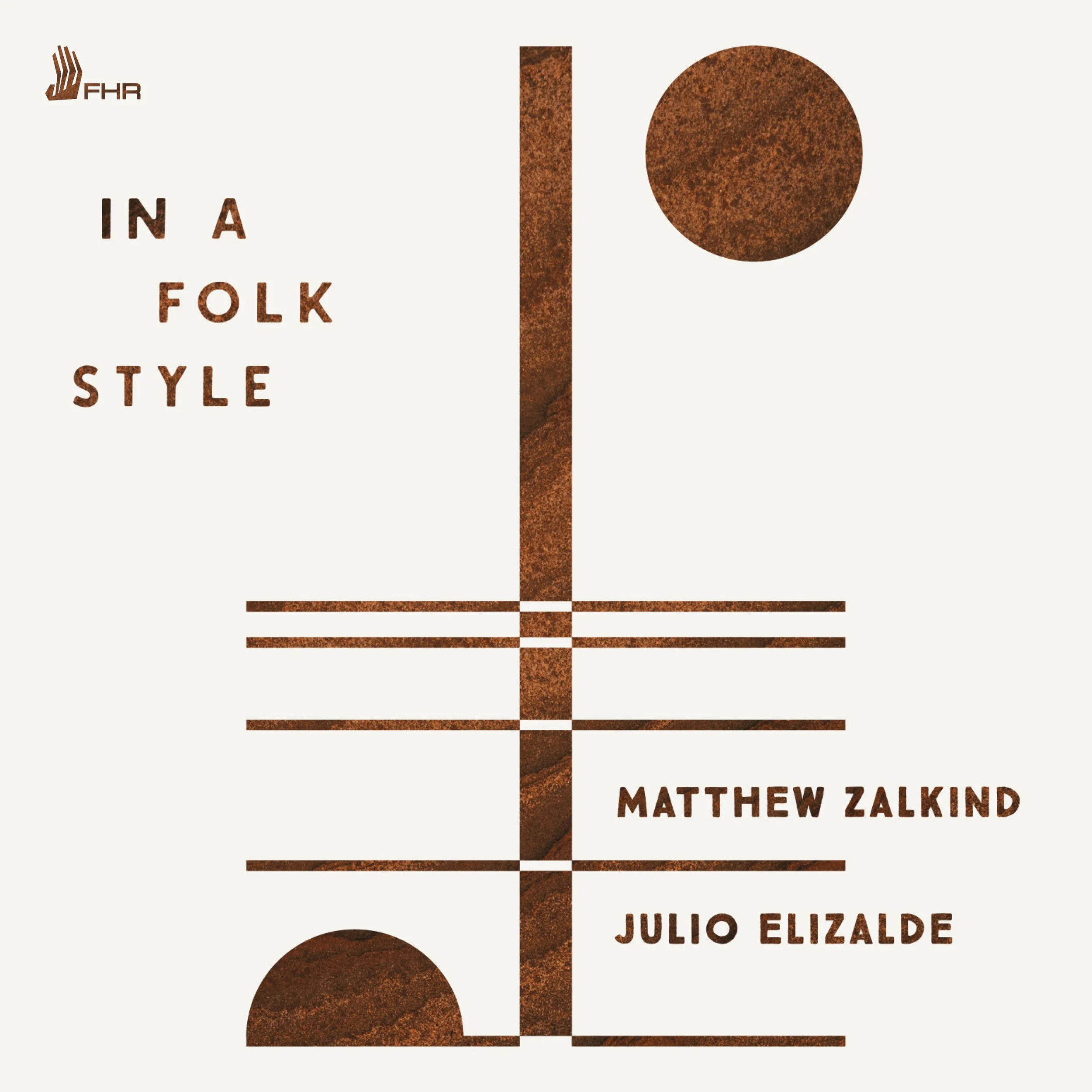
Cellist Matthew Zalkind Announces In a Folk Style
New Album with Pianist Julio Elizalde
Music by Schumann, Tsintsadze, Chopin, Dvořák, and Burleigh
Out January 22, 2027 on First Hand Records
CDs or press downloads available upon request.
Matthew Zalkind | First Hand Records | Julio Elizalde
On January 22, 2027, Denver, CO and Madison, WI-based cellist Matthew Zalkind will release In a Folk Style, his new album with pianist Julio Elizalde. This is Zalkind’s debut recording on First Hand Records. In a Folk Style features a program inspired by folk traditions and dance idioms, centered around Robert Schumann’s beloved work of the same title.
The album includes Schumann’s Fünf Stücke im Volkston (“Five Pieces in a Folk Style”), Op. 102, Sulkhan Tsintsadze’s Five Pieces on Folk Themes, Frédéric Chopin’s Introduction and Polonaise Brillante, and Antonín Dvořák’s In Folk Tone, Op. 73, alongside Zalkind’s own transcription of Harry Burleigh’s Southland Sketches. With this program, Zalkind sought to explore the many ways composers draw upon folk melodies, rhythms, and styles to create deeply personal concert works.
“In a Folk Style brings together five composers – from five different countries and spanning two centuries – who, in their own way, turned toward the sound of home in their duo writing,” says Zalkind. The recording highlights a wide range of musical voices and traditions, united by a shared spirit of storytelling, song, and dance.
Praised for his “impressive refinement, eloquent phrasing, and singing tone” by The New York Times, American cellist Matthew Zalkind regularly performs throughout the United States and abroad as a recitalist, soloist, and chamber musician. An active chamber musician, Zalkind has appeared at Carnegie Hall’s Weill Recital Hall, the Kennedy Center’s Terrace Theater, New York’s Alice Tully Hall, and the Metropolitan Museum of Art. Zalkind is a dedicated teacher and currently teaches at the University of Wisconsin in Madison. His students have been recognized on national and international concert stages.
A musician of "compelling artistry and power" (Seattle Times) the gifted American pianist Julio Elizalde is a multifaceted artist who enjoys a versatile career as soloist, chamber musician, artistic administrator, educator, and curator. He has performed in many of the major music centers throughout the United States, Europe, Asia, and Latin America to popular and critical acclaim. Since 2014, he has served as the artistic director of the Olympic Music Festival near Seattle, Washington. He tours internationally with violinists Sarah Chang and Ray Chen, and currently serves on the faculty of the San Francisco Conservatory of Music.
“My friend and duo partner Julio Elizalde and I have been living with this program for a while now, and what struck us most, putting it together, is how much these six pieces have in common despite coming from such different places,” says Zalkind. “This music holds some of the most heartfelt singing, the most raucous dancing, and the most infectious, sincere writing one could imagine – and turns popular music ‘for the people’ into chamber music perfectly built for cello and piano.”
In the album’s liner notes, Zalkind traces the story behind each work.
Chopin wrote very little for any instrument other than solo piano, which makes the Introduction and Polonaise Brillante in C major, Op. 3, one of his rare chamber works, alongside the Cello Sonata. He began it in October 1829 while staying at the country estate of Prince Antoni Radziwiłł, an amateur cellist and early patron, and wrote it with the Prince’s own playing in mind. The Introduction followed in 1830. Because the original cello part is modest next to the piano’s, generations of cellists, from Emanuel Feuermann to Leonard Rose, have “borrowed” material from the piano. Zalkind and Elizalde built their own version in that tradition, “really just the latest entry in a long line of cellists to do so.”
Dvořák wrote his first set of Slavonic Dances in 1878 at the request of his publisher, Simrock, who hoped to match the success of Brahms’s Hungarian Dances. The set made Dvořák famous almost overnight, although all of its folk-flavored melodies are his own invention. He began a cello-and-piano arrangement of No. 3 but never finished it, and Josef Chuchro completed it after his death. Dvořák did finish No. 8, the fiery G-minor furiant, writing it out himself as a gift for a cellist friend. Zalkind calls the pair “genuinely virtuosic.”
Sulkhan Tsintsadze was a cellist in the Tbilisi String Quartet before becoming one of Georgia’s most important 20th-century composers. His Five Pieces on Folk Themes (1950) show an insider’s command of the instrument. The movements sketch scenes of Georgian folk life: an ox-cart driver’s song, an imitation of the chonguri folk lute, a stamping wrestlers’ song, a tender lullaby and an exuberant closing dance. Championed by cellists from Daniil Shafran onward, they have become staples of the repertoire.
Harry T. Burleigh was a composer and singer and the first to bring the African American spiritual into the concert hall. He studied with Dvořák in New York in the 1890s and is widely believed to have introduced him to the spirituals that shaped the “New World” Symphony and the “American” Quartet, which made pairing the two composers a natural choice. Southland Sketches (1916) is Burleigh’s violin-and-piano reworking of his piano suite From the Southland, heard here in Zalkind’s own cello transcription. Its four movements draw on spirituals and Southern song, set in Burleigh’s late-Romantic harmonic language.
Schumann wrote Fünf Stücke im Volkston in 1849, one of his most productive years. It is the only work he wrote specifically for cello and piano – a second set from 1853 was never published, and Clara Schumann destroyed the manuscript in 1893. As with Dvořák, the “folk style” is invented rather than borrowed, “more inward than rustic,” in Zalkind’s words. The five short ABA-form pieces have unpredictable phrase lengths. They move from the dry humor of the first, subtitled Vanitas vanitatum, through a lullaby-like second movement and a deeply inward third, to a sunny, heroic fourth. The finale ends the cycle, as Zalkind puts it, “not with warmth, but with real ferocity.”
The album closes with Zalkind’s own transcription of “Dobrú noc, má milá” (“Good night, my darling”), the first of Dvořák’s four songs In Folk Tone, Op. 73 (1886), settings of Slovak folk texts.
More about Matthew Zalkind: Zalkind was awarded First Prize in the Washington International Competition, as well as top prizes in the Beijing International Cello Competition and Korea’s Isang Yun Gyeongnam International Competition. As a soloist, Matt has performed recitals at the Phillips Collection in Washington, DC, the Moscow Conservatory in Russia, the Kennedy Center’s Terrace Theater in Washington, DC, and the Beijing Concert Hall in China. He has appeared as a concerto soloist with the Utah Symphony, Albany Symphony, Hangzhou Philharmonic, Musica Viva Moscow Chamber Orchestra, Tongyeong International Music Festival Orchestra, Music Academy of the West Festival Orchestra, Juilliard Symphony Orchestra, and numerous other North American orchestras. He has performed under the baton of celebrated conductors including Ludovic Morlot, Thierry Fischer, Giancarlo Guerrero, and David Alan Miller. As a former member of the acclaimed Harlem String Quartet, he toured internationally with jazz legends Stanley Clarke, Chick Corea, and Gary Burton. He regularly participates in prominent chamber music festivals, including Marlboro and Musicians from Marlboro tours. Alongside his wife, cellist Alice Yoo, Matt is the Co-Artistic Director of the Denver Chamber Music Festival, a premier destination for world-class chamber music in Colorado. Matt holds bachelor’s and master’s degrees from The Juilliard School, as well as a Doctor of Musical Arts degree from the University of Michigan. A native of Salt Lake City, his primary mentors included Richard Hoyt, Pegsoon Whang, Hans Jørgen Jensen, Timothy Eddy, and Richard Aaron. Matt performs on a rare Italian cello made by Florentine maker Luigi Piattellini in 1760.
More About Julio Elizalde: Julio Elizalde is a founding member of the New Trio with violinist Andrew Wan, co-concertmaster of the Montréal Symphony and Patrick Jee, cellist of the New York Philharmonic. The New Trio was the winner of both the Fischoff and Coleman National Chamber Music Competitions and is the recipient of the Harvard Musical Association's prestigious Arthur W. Foote Prize. As part of the New Trio, Julio has performed for leading American politicians such as President Bill Clinton, Secretaries of State Condoleezza Rice and Henry Kissinger, and the late Massachusetts Senator Ted Kennedy. He was a featured performer on the soundtrack of the 2013 film Jimmy P, composed by Academy Award-winner Howard Shore. Elizalde is a passionately active educator. In 2013, he served as a visiting professor of piano at the University of Puget Sound in Tacoma, Washington and has given piano and chamber music masterclasses throughout the United States at major conservatories and universities. He has also appeared at various summer music festivals including Yellow Barn, Taos, Caramoor, Bowdoin, Kneisel Hall, and the Music Academy of the West. In 2012, Julio was the youngest juror ever selected at the Fischoff National Chamber Music Competition held at the University of Notre Dame in South Bend, Indiana. Originally from the San Francisco Bay Area, Elizalde received a bachelor of music degree with honors from the San Francisco Conservatory of Music, where he studied with Paul Hersh. He holds master’s and doctor of musical arts degrees from the Juilliard School in New York City, where he studied with Jerome Lowenthal, Joseph Kalichstein, and Robert McDonald.
In a Folk Style
Matthew Zalkind, cello
Julio Elizalde, piano
Release Date: January 22, 2027
First Hand Records
Tracklist:
Frédéric Chopin (1810–1849)
1. Introduction and Polonaise Brillante, Op. 3 (1829–30) [9:25]
Antonín Dvořák (1841–1904)
Slavonic Dances, Op. 46 (1878) (arr. Dvořák, 1891)
2. No. 3 in A-flat major, B83 (compl. J. Chuchro) [4:06]
3. No. 8 in G minor, “Furiant,” B172 [4:21]
Sulkhan Tsintsadze (1925–1991)
Five Pieces on Folk Themes (1950) [14:34]
4. No. 1. Arobnaya [5:20]
5. No. 2. Chonguri [1:34]
6. No. 3. Sachidao [2:34]
7. No. 4. Nana [3:07]
8. No. 5. Plyasovaya [1:58]
Henry “Harry” Thacker Burleigh (1866–1949)
Southland Sketches (1916) (transcr. M. Zalkind, 2024) [11:19]
9. I. Andante [2:29]
10. II. Adagio ma non troppo [2:50]
11. III. Allegretto grazioso [3:15]
12. IV. Allegro [2:43]
Robert Schumann (1810–1856)
Fünf Stücke im Volkston, Op. 102 (1849) [15:17]
13. I. Mit Humor [2:52]
14. II. Langsam [3:37]
15. III. Nicht schnell, mit viel Ton zu spielen [4:00]
16. IV. Nicht zu rasch [1:54]
17. V. Stark und markiert [2:53]
Antonín Dvořák
In Folk Tone, Op. 73, B146 (1886)
18. No. 1. Dobrú noc, má milá (“Good night, my darling”) (transcr. M. Zalkind, 2024) [3:13]
Total Time: [62:24]
Recorded at Oktaven Audio in Mount Vernon, New York
May 24-25, 2024 and December 27, 2025
Recorded, Edited and Produced By Ryan Streber
Album Cover Design by Leah Vautar
Artwork by David Murphy