
Oct. 11: Pianist Sarah Cahill Performs No Ordinary Light – Presented by the Myra Foundation as part of Concerts in the Galleries Series
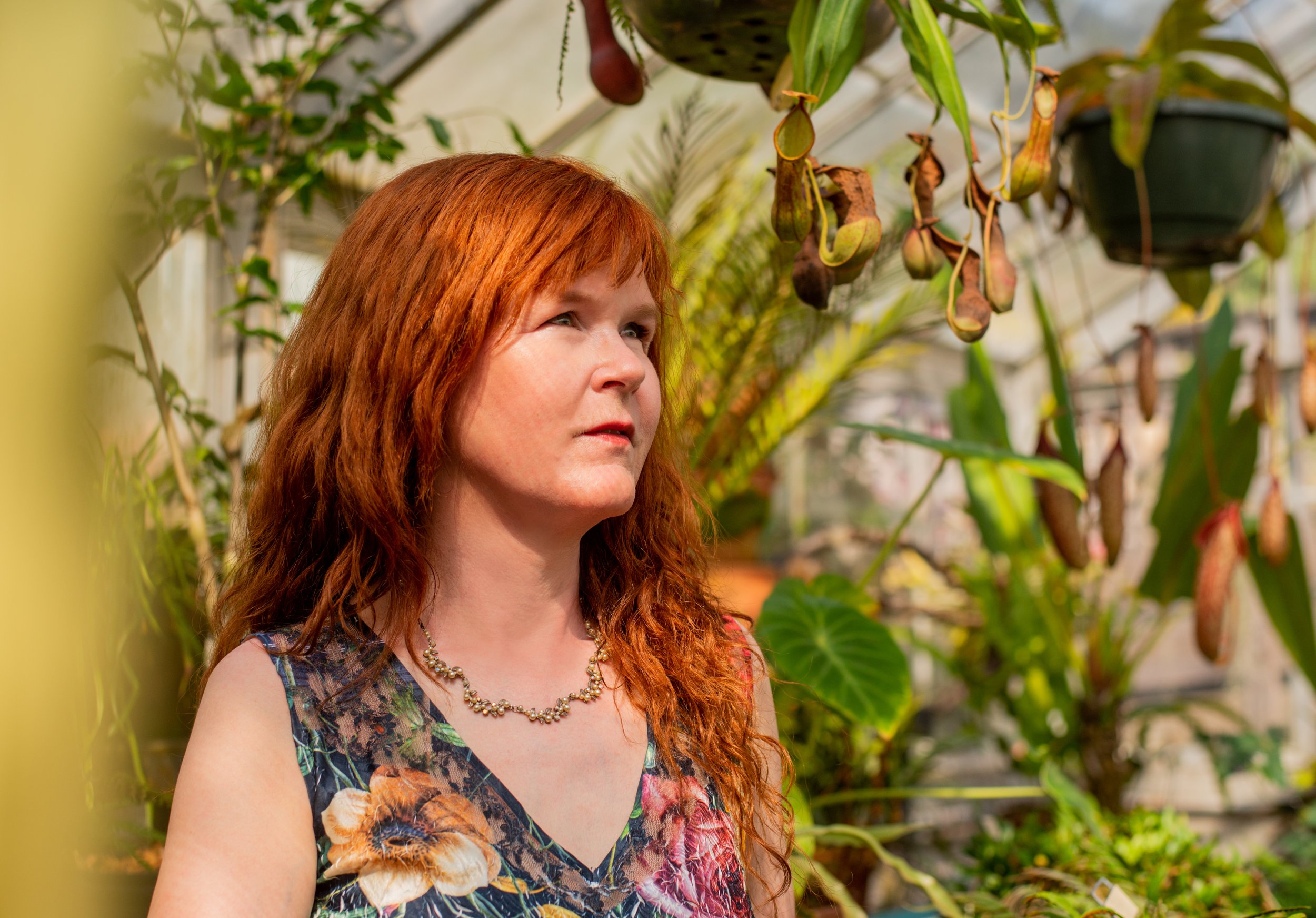
Photo of Sarah Cahill by Kristen Wrzesniewski available in high-resolution at
jensenartists.com/artists-profiles/sarah-cahill
Myra Foundation Presents:
Concerts in the Galleries with Pianist Sarah Cahill
Performing No Ordinary Light
Featuring the Music of Jean-Henri d’Anglebert, Gabriel Fauré, Ricardo Viñes, Robert Helps, Samuel Adams, William Bolcom, Tom Constanten, Clarice Jensen, Lou Harrison, Maggi Payne, Zenobia Powell Perry, François Couperin, and Maurice Ravel
Sunday, October 11, 2026 at 2pm | 261 Centennial Dr. Stop 7305 | Grand Forks, ND
Tickets and More Information
“Pianist Sarah Cahill commands a near-godlike status among fans of contemporary classical music”
–NPR Music
Watch Sarah Cahill’s NPR Tiny Desk Concert
Grand Forks, ND – Pianist Sarah Cahill, “as tenacious and committed an advocate as any composer could dream of” (San Francisco Chronicle), is presented by the Myra Foundation as part of its Concerts in the GalleriesSeries on Sunday, October 11, 2026 at 2pm at the North Dakota Museum of Art (261 Centennial Dr.). Cahill is a beloved guest artist at this institution, having performed six times in this series, as well as giving a marathon performance of her ongoing investigative project, The Future is Female, in 2018.
This year, Cahill will perform a new program titled No Ordinary Light, an emotive project focused on the theme of homage and loss. No Ordinary Light explores how composers over the centuries have paid homage to one another, cherishing and immortalizing through music. This program also honors the experience of personal grief as well as celebrating the memories of our loved ones. This concert is dedicated to the memory of Laurel Reuter, the visionary founder and longtime director of the North Dakota Museum of Art. New commissioned works are by Samuel Adams, in memory of his mentor and godfather Ingram Marshall, and Clarice Jensen’s Homage to Ryuichi Sakamoto, combined with classical and 20th century works. This concert program will also feature the music of Jean-Henri d’Anglebert, Gabriel Fauré, Ricardo Viñes, Robert Helps, William Bolcom, Tom Constanten, Lou Harrison, Maggi Payne, Zenobia Powell Perry, François Couperin, and Maurice Ravel. Cahill's residency at the museum includes school outreach activities and a master class.
"The light has gone out, I said, and yet I was wrong. For the light that shone in this country was no ordinary light."
– Jawaharlal Nehru on the assassination of Mahatma Gandhi
“The North Dakota Museum of Art is one of the most beautiful and inspiring contemporary art museums in the country, and it's always a great pleasure to perform there in the world-class concert series,” says Cahill.
About the Music on the Program
During the 17th century, Jean-Henri d’Anglebert was a prominent figure in the rising popularity of the harpsichord over the lute. The growing momentum of the former amid the public was further ushered along by Jacques Champion de Chambonnières, the man widely considered to be the father of the French harpsichord school. Chambonnières and his teachings would go on to bolster the recognition of musicians like Louis Couperin, Nicolas Lebègue, Johann Jakob Froberger, and Jacques Hardel, as well as Jean-Henri d’Anglebert, which may be the reason behind why d’Anglebert wrote the Tombeau de M. de Chambonnières, seemingly a gesture of homage from student to teacher upon the latter’s passing.
Tom Constanten is best known for being the first keyboard player for the Grateful Dead. He and Phil Lesh (bassist for the Grateful Dead) studied composition at Mills College with Luciano Berio. Constanten is a classically trained pianist whose playful compositions often conceal encrypted messages and what he calls “time release humor.” In 1977 he wrote a waltz called Dejavalse, and later revisited the material with new approaches. At Mills College, he befriended fellow student William Bolcom, and dedicated Dejavalise to him in 1985. The score is inscribed “to/for (six-eight, who do we appreciate) Bill Bolcom.”
Robert Helps composed Hommage à Fauré as part of Trois Hommages (1972), a trilogy of works and one of his most popular and often recorded works. The first two pieces, which include à Fauré and à Rachmaninoff, expand upon the opulent pianism and poignant harmonies that are hallmarks of the composers to which each piece pays tribute.
Commissioned by Cahill, Samuel Adams’ solo piano work, Prelude (Hammer the Sky Bright), is a tribute to composer Ingram Marshall (1942–2022). A former resident of the San Francisco Bay area, Ingram Marshall’s work greatly influenced a number of composers and musicians from the area, including Adams – who studied with Marshall and considered him his mentor – and Cahill, who frequently performs Marshall's music and commissioned several works from him. Adams says of the work: “Prelude: Hammer the Sky Bright pays tribute to Ingram’s free-form, unpredictable sense of structure and highly impressionistic, almost ambient musical surfaces. His music often embraced the idea that form can be gradual and elusive—like late Sibelius—with the secrets of a piece only occasionally appearing close to its surface, like sunken cathedrals.”
American composer William Bolcom wrote a set of three Ghost Rags for piano, with the first of the trio written in 1970 as a tribute to Bolcom’s late father, whose spirit Bolcom said he often felt nearby while working on the piece. The three works collectively explore the experience of grief and loss, with the first rag being one of the most well-known contemporary rags, particularly of the ragtime revival in the 1970s. The first rag moves with a poised, emotive, lyrical style, fittingly echoing the feeling behind the title of Graceful Ghost Rag.
Gabriel Fauré composed his Barcarolles over a period of four decades, and they show the evolution of his distinct compositional voice. The barcarolle was a traditional boat song of the Venetian gondoliers – its characteristics are a rhythm copying the gondolier’s stroke in the water and a moderate 6/8 time. Fauré used the title of barcarolle but didn’t adhere religiously to the form. One important thing to note about Fauré was that he was ambidextrous – could use both right and left hands equally well – and this comes through in the barcarolles. In more than one piece, the melody is in the middle register, with the high and low registers being used for accompaniment of the central melody. One writer compared this to a mirror image on the water where the major image is in the middle, with reflections at the top and bottom.
The brilliant Spanish pianist Ricardo Viñes premiered great works by his good friend Ravel (Gaspard de la Nuit and Jeux d’eau) and Debussy, and was Francis Poulenc’s piano teacher. He composed four Hommages, for Ravel, Fauré, Satie, and Léon-Paul Fargue. The title of his tribute to Fauré, En Verlaine mineur, refers to Fauré’s songs setting poetry by Paul Verlaine, and there is a quote from one of Fauré’s songs embedded in this poignant minuet.
Clarice Jensen says of Ryuichi Sakamoto and how he influences her work: “I count myself so lucky to have met and recorded for Ryuichi Sakamoto in New York City. His music, persona and person inspired me with their sincerity and beauty, depicting at once simplicity and complicated, deep emotion. Despite working with him only a few times, I feel he was a teacher of sorts, and still lives as an archetype for me, inspiring me to not shy from expressing or creating beauty. Each of the movements for Sarah [Cahill] has an embedded motif from Sakamoto's work: Earth - Andata, Fire - Merry Christmas Mr. Lawrence, Water - solari.”
In addition to being an adventurous composer and skilled percussionist, Lou Harrison was fond of writing music in honor of his colleagues, friends, and fellow musicians he admired. Homage to Milhaud is inspired by Darius Milhaud, who, like Harrison, was a longtime teacher at Mills College in Oakland. Harrison wrote his Fugue to David Tudor at Black Mountain College while he was teaching there. Harrison often worked with David Tudor, who was himself a pioneering pianist-composer.
Cahill commissioned Maggi Payne’s Holding Pattern in 2001 to honor the centennial birth year of pioneering composer Ruth Crawford Seeger. Of Holding Pattern, Payne says: “When Sarah Cahill approached me with the prospect of composing a work for piano in tribute to Ruth Crawford Seeger, particularly in reference to the Nine Preludes which Sarah had just recorded, I was intrigued. Ruth Crawford Seeger’s interest in timbre, particularly as represented in Prelude 6 and 9, spurred this brief work. This delicate timbral exploration’s last sustained notes are those that begin Prelude 6. The Mystico marking of Prelude 6 and the Tranquillo of Prelude 9 are reflected in the character of Holding Pattern.”
Zenobia Powell Perry was a composer, professor, and civil rights activist of African American and Creek Indian heritage. She composed Homage in 1990. The work utilizes a variety of different textures and techniques, including octaves, dense chords, and chromaticism. Homage is dedicated to Perry's former teacher William Dawson for his ninetieth birthday, and is based on the spiritual “I’ve Been Buked and I’ve Been Scorned.”
Francois Couperin’s works tend to bear picturesque titles and reflect certain moods or energies in the way they unfold. Le Tic-Toc-Choc, ou Les Maillotins, is one of the most well known works of harpsichord repertoire. Though also performed on the modern piano, the work still embodies its topical reference with clever artistic style. The music is written in such a way as to mirror the rhythmic precision of a clock and the references little hammers or mallets. The experience of hearing this piece brings to mind the passage of time in a very direct and palatable way. Les Amusements is another of Couperin’s compositions originally for solo harpsichord and despite the somber air of the melody, the work nonetheless conveys a parallel sense of warmth and subtle sweetness more in line with its title.
Maurice Ravel composed Le Tombeau de Couperin between 1914 and 1917, during and after World War I – a devastating conflict in which Ravel took direct part as a truck driver in the French Army, thus feeling the impact of the war first hand. The music is not only a memorialization of Francois Couperin but the suite is also dedicated to six dear friends of Ravel lost at the cost of the war. Each of the six movements is dedicated to one of those friends and the lives they lived.
About Sarah Cahill: Sarah Cahill, hailed as “a sterling pianist and an intrepid illuminator of the classical avant-garde” by The New York Times, has commissioned and premiered over seventy compositions for solo piano. Composers who have dedicated works to Cahill include John Adams, Terry Riley, Frederic Rzewski, Pauline Oliveros, Julia Wolfe, Roscoe Mitchell, Annea Lockwood, and Ingram Marshall. She was named a 2018 Champion of New Music, awarded by the American Composers Forum (ACF).
Cahill’s latest project is The Future is Female, an investigation and reframing of the piano literature featuring more than seventy compositions by women around the globe, from the Baroque to the present day, including new commissioned works. Recent and upcoming performances of The Future is Female include concerts at The Barbican, Metropolitan Museum, Carolina Performing Arts, National Gallery of Art, Carlsbad Music Festival, Detroit Institute of Arts, University of Iowa, Bowling Green New Music Festival, Berkeley Art Museum and Pacific Film Archive, North Dakota Museum of Art, Mayville State University, the EXTENSITY Concert Series’ Women Now Festival in New York, and the Newport Classical Music Festival. Cahill also performed music from The Future is Female for NPR Music’s Tiny Desk Concert series.
Sarah Cahill’s discography includes more than twenty albums on the New Albion, CRI, New World, Tzadik, Albany, Innova, Cold Blue, Other Minds, Irritable Hedgehog, and Pinna labels. Her three-album series, The Future is Female, was released on First Hand Records between March 2022 and April 2023. These albums encompass 30 compositions by women from around the globe, from the 17th century to the present day, and include many world premiere recordings.
Cahill’s radio show, Revolutions Per Minute, can be heard every Sunday evening from 6 to 8pm on KALW, 91.7 FM in San Francisco. She is on the faculty of the San Francisco Conservatory and is a regular pre-concert speaker with the San Francisco Symphony and the Los Angeles Philharmonic.
For more information, visit www.sarahcahill.com.
For Calendar Editors:
Description: Pianist Sarah Cahill, described by the San Francisco Chronicle as “tenacious and committed an advocate as any composer could dream of,” will perform on the Myra Foundation’s Concerts in the Galleries Series at the North Dakota Museum of Art. Cahill will perform No Ordinary Light, an emotive new commissioning project devoted to the theme of homage. The program will feature music by Jean-Henri d’Anglebert, Gabriel Fauré, Ricardo Viñes, Robert Helps, Samuel Adams, William Bolcom, Tom Constanten, Clarice Jensen, Lou Harrison, Maggi Payne, Zenobia Powell Perry, François Couperin, and Maurice Ravel.
Concert details:
Who: Pianist Sarah Cahill
Presented by the Myra Foundation as part of the Concerts in the Galleries Series
What: No Ordinary Light - Featuring the Music of Jean-Henri d’Anglebert, Gabriel Fauré, Ricardo Viñes, Robert Helps, Samuel Adams, William Bolcom, Tom Constanten, Clarice Jensen, Lou Harrison, Maggi Payne, Zenobia Powell Perry, François Couperin, and Maurice Ravel
When: Sunday, October 11, 2026 at 2pm
Where: North Dakota Museum of Art, 261 Centennial Dr., Stop 7305 Grand Forks, ND 58202
Tickets and More information: https://dancepalace.org/event/sarah-cahill-no-ordinary-light-piano-concert/