June 5: Simone Dinnerstein Makes Label Debut on Naïve in Hourglass - Music by Philip Glass - with Baroklyn
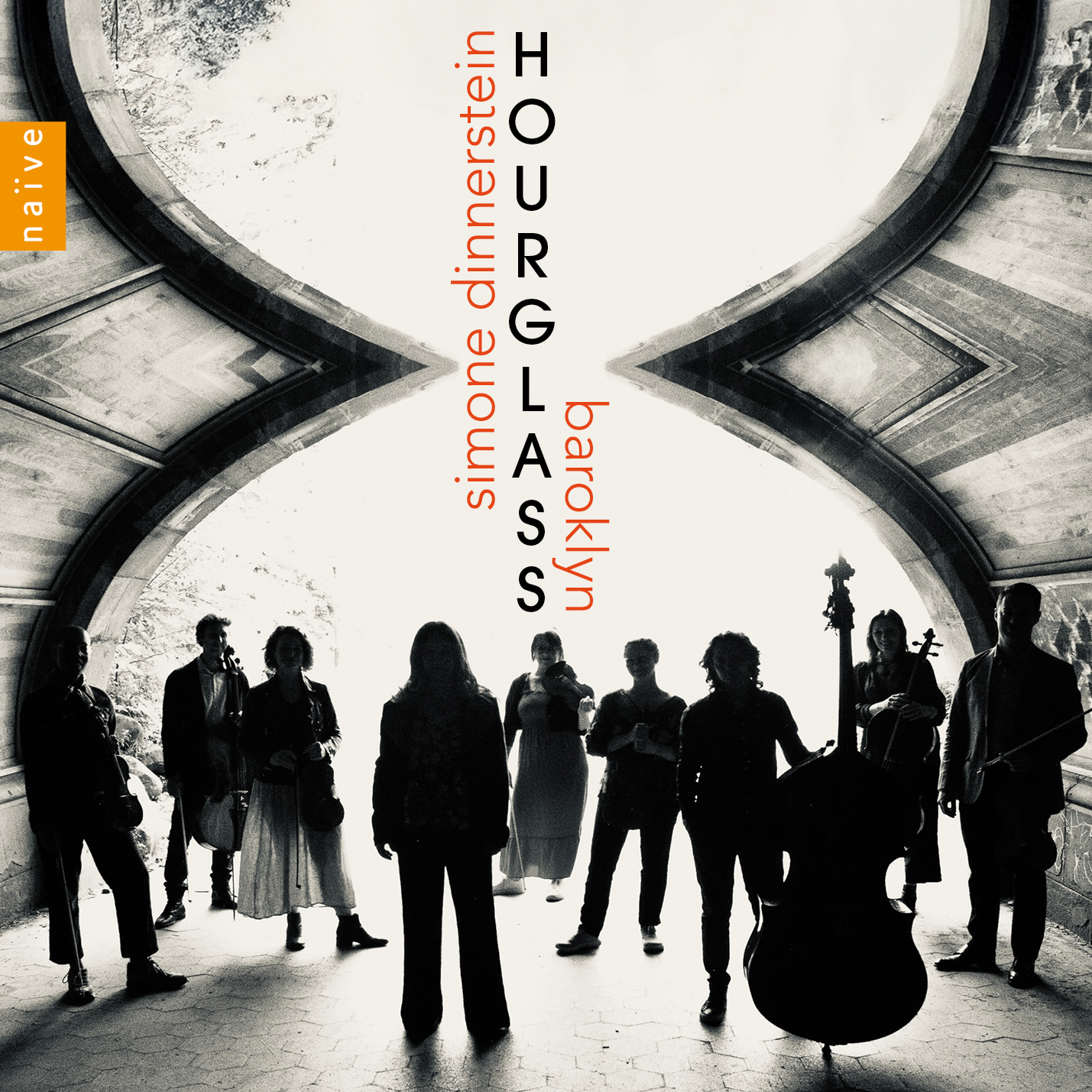
Simone Dinnerstein Makes Label Debut on Naïve in Hourglass with Baroklyn
Featuring Philip Glass’s Suite from The Hours and Tirol Concerto for Piano and Orchestra
Release Date: June 5, 2026
Pre-Save
First Single – The Hours – Out Today
Listen Here
Review downloads & CDs available upon request.
“it is Dinnerstein’s unreserved identification with every note she plays that makes her performance so spellbinding” – The Washington Post
simonedinnerstein.com | naiverecords.com
March 19, 2026 – On June 5, 2026, GRAMMY-nominated American pianist Simone Dinnerstein, one of the most distinctive voices in classical music today, releases her first album on naïve since signing with the label earlier this year. Titled Hourglass, it features Philip Glass’s Suite from The Hours and his Tirol Concerto for Piano and Orchestra (Piano Concerto No. 1). The album, recorded with Dinnerstein’s own ensemble Baroklyn, is another milestone in her close artistic association with the renowned composer, who celebrates his 90th birthday in January 2027. The first single, The Hours, is out today.
Simone Dinnerstein first came to wider public attention in 2007 through her recording of J.S. Bach’s Goldberg Variations, reflecting an aesthetic that was both deeply rooted in the score and profoundly personal. This approach extends to all of the repertoire she performs, from Bach to Glass, with whom she has collaborated for over ten years. Glass wrote his Piano Concerto No. 3 for Dinnerstein in 2017, co-commissioned by twelve orchestras from across North America. She recorded and released it the following year on her acclaimed album Circles. NPR reported, “Dinnerstein's creamy tone and elastic phrasing gives the music an air of Schubertian warmth and wistfulness.”
Dinnerstein says, “In my reading of the works on this album with Baroklyn, we focused on the larger beats. Instead of lining up each single step, we wanted every voice to have its own ebb and flow, coinciding with other voices in certain larger pulse divisions. This allows us to hear the particular phrasing of the voices more independently, and brings out the strangeness in the music. The goal was to create a whole, but a whole made up of all the distinctive particularities of the individual lines and musicians.”
Philip Glass’s Suite from The Hours (arranged by Michael Riesman) is a three-movement piano concerto taken from Glass’s film score for Stephen Daldry’s film The Hours starring Nicole Kidman, Julianne Moore, and Meryl Streep, an adaptation of the novel by Michael Cunningham. The score received Golden Globe, GRAMMY, and Academy Award nominations, along with winning a British Academy Film Award in Film Music. It is a veritable manifesto of Glass’s expressive simplicity, in which layers and motifs are inconstant, subtly transform, and give rise to a richly wrought polyphonic universe. In this recording, Baroklyn’s expansive phrasing and serene assurance, and Dinnerstein’s intense sonority, combine to highlight the music’s almost Classical elegance, as if it were a newly discovered Mozart concerto.
Glass’s Tirol Concerto, composed in 2000, went unperformed in New York for more than 20 years until Dinnerstein’s performance of the work with the Brooklyn Orchestra and Olivier Glissant in November 2023. Two brief, fleeting movements in neo-Baroque vein enclose a broad elegy—music for an imagined film—threaded with numerous reminiscences of Glass’s Etudes for piano, which he began writing in 1994. Glass based the concerto on melody fragments of traditional Austrian Volkslied, or folk music, in the Tyrolean tradition. Dinnerstein says of the piece, “The second movement of the Tirol is what first drew me to it. Built almost as a set of variations, the sound is lush and pulsating, and its mood relates to his Symphony No. 3 for strings. I love the play between intense lyricism and a feeling of austerity, so reminiscent of Schubert’s writing.”
Dinnerstein recorded Hourglass with the ensemble that she founded and directs, Baroklyn (a portmanteau of Baroque and Brooklyn, her home New York borough). She describes the ensemble as “a community that shares the artistic vision that is most important to me, that music should be creative and new. We avoid ‘fixing’ our interpretations, to keep the music from becoming static. We have a plan, but are open to the moment. This way of making music is dependent upon listening, openness to change, and trust. It results in a feeling of togetherness.”
Dinnerstein sees a natural affinity between the music of Philip Glass and that of J.S. Bach in their deeply polyphonic visions, quest for the absolute independence of each line, and an abiding concern for the singing quality of musical phrases.
She says:
“When I think about the music of Philip Glass, I think about time. The music is intricate and polyphonic. It’s layered, with patterns that keep shifting in the subtlest of ways. Though the harmonies are clearly important in the musical narrative, Glass’s music is multi-linear in a way that evokes the music of Bach. It is music on the horizontal, as opposed to the vertical. If anything, it is circular music. . .
Glass’s music is famously known for its repetitions. Every repetition is a reaction to the one before and an anticipation of one to come. We hear differently because our hearing changes with each note—we carry the whole unfolding of the music with us as we listen. We hear it as a constant becoming, not as a set of musical facts. This is exactly why I don’t hear Glass’s music as mechanical. It makes me think about the hourglass rather than the factory clock. A clock divides time into discrete, measured steps, in a way that in many parts of contemporary life feels natural. In music we can feel a vestige of the unnaturalness of that relentless pulse, an unhuman rigidity. Like our experience of time, music sometimes seems to move faster, sometimes slower, sometimes chaotically, sometimes evenly. The hourglass, with its unsubdivided and embodied flow, is how I think of this music.”
Since her recording of the Goldberg Variations, in addition to establishing a busy performing career, Simone Dinnerstein has made fourteen albums—all of which have topped the Billboard classical charts. She has played with orchestras ranging from the New York Philharmonic and the Montreal Symphony Orchestra to the London Symphony Orchestra and the Orchestra Sinfonica Nazionale Rai. She has performed in venues from Carnegie Hall and the Kennedy Center to the Berlin Philharmonie, the Vienna Konzerthaus, the Seoul Arts Center, and the Sydney Opera House.
About Simone Dinnerstein: www.simonedinnerstein.com
Track List & Credits:
Hourglass
Release Date: June 5, 2026 | naïve
Music by Philip Glass | Simone Dinnerstein, director and piano | Baroklyn
Suite from The Hours (2002)
1. I [11:17]
2. II [8:59]
3. III [6:57]
Tirol Concerto for Piano and Orchestra (Piano Concerto No. 1) (2000)
4. Movement I [6:28]
5. Movement II [16:40]
6. Movement III [6:33]
Recording Producers: Silas Brown, Simone Dinnerstein
Sound Engineering: Silas Brown, Doron Schachter, Richie Clarke
Editing: Silas Brown, Simone Dinnerstein
Mixing and Mastering: Silas Brown (Legacy Sound)
Recorded at Merkin Hall, Kaufman Music Center, New York, NY, May 25-26, 2025
Summary: This album is the first release on naïve from American pianist Simone Dinnerstein, one of the most distinctive voices in classical music today. Recorded with Dinnerstein's own string ensemble, Baroklyn, it immerses listeners in the sound world of Philip Glass, continuing the GRAMMY-nominated pianist's close artistic association with renowned composer, and features his Suite from The Hours and Tirol Concerto.
Upcoming Performances:
March 21, 2026: Chandler Center for the Arts – Randolph, VT
March 27, 2026: University of Chicago – Chicago, IL
April 17, 2026: Carnegie Hall – New York, NY
April 25, 2026: St. Peter's Community Arts Academy – Geneva, NY
May 17, 2026: Sands Point Preserve Conservancy – Sands Point, NY
May 21, 2026: Concordia Chamber Players – Solebury, PA
May 27, 2026: Library of Congress – Washington, D.C.
June 9, 2026: Naumburg Orchestral Concerts, Central Park – New York, NY
June 13, 2026: Rockport Chamber Music Festival – Rockport, MA
June 14, 2026: Music Mountain Summer Festival – Falls Village, CT
June 25, 2026: Flagstaff Piano Festival – Flagstaff, AZ
June 30, 2026: Lyra Music – Beacon, NY
For details: www.simonedinnerstein.com/concerts-upcoming